Showing posts with label advertising history. Show all posts

Thursday, December 31, 2015

The Book Motif Illusion

When it came to selecting a design for the cover of my new book Blooks: The Art of Books That Aren't, I immediately thought of the graphic device in which a two-dimensional image of an iconic or substantial book is used to give a piece of ephemera psychological and aesthetic clout. This motif has been frequently used since the nineteenth century for the design of menus, needle books, advertisements, invitations, greeting cards and pamphlets. You will see some of them in my exhibition at the Grolier Club this winter. 

The 2-D (usually closed) book motif has been used to represent many genres of texts and bookbinding formats. There are those that represent account books, reference books, literary works and memory books. In all cases, the iconic image of a book contributes a sense of importance, permanence and beauty. For the objects made in this form, the book motif is essential to their message and commercial success. The image of the book alone instills confidence in the buyer and inspires people to collect and save the objects. The examples below illustrate the use of this charming motif.   

This die-cut Calument Baking Powder  advertisement shown represents a half-leather binding, the binding style most of us think of when we describe a "real book." This sturdy binding style was used internationally throughout the nineteenth and twentieth centuries by trade, edition and hand binders.


Sometimes, as seen on this Uncle Sam's Macaroni trade card, the book is represented as a portal. I've seen the book-as-portal device work both ways. Sometimes something is popping out of the book and other times, there is a portal into the book, that suggests you are entering into a special, transformative world of one kind or another.


There are many book-shaped trade cards, here are a few examples.

Trade card for Hood's Sarsparilla
Peter, Paul and Brothers Book and Stationary Store, Buffalo, NY.

From the 1920s through 1950s, the book motif was often used for the design of greeting cards on many subjects, including get well messages, birthdays, anniversaries, religious rites of passage, and more. Many include bookish messages and puns on book-talk. They often focus on the anthropomorphic nature of books, comparing our lives to books, with the pages being the days, years the chapters and so on. These can be very amusing. A Book of Conundrums card, is a faux riddle book. If you visit my exhibition, you will see an entire case of book cards.  


Occasionally, I come across the book motif used as a sales tag. This cardboard retail garment tag has an insert photograph of Shirley Temple wearing a "Shirley Temple Brand Cinderella Frock."  On the back of the tag is stamped "3628," 1930s.


I don't own all of the objects illustrated in this post, but I did just purchase the Edy's Character Study of Sweets ice cream parlor (California, and yes, the Edy's we now know for their ice cream) menu shown below. I'm sure that the College Ice soda, listed on the first page would make us smarter.


I hope to see many of you at my exhibition. I'd love to meet you. Please consider attending one of the free lunchtime tours, every Thursday from January 28 through March 10 or the panel on February 2. Please consider supporting my work on blooks by purchasing this book trhough this website. Warm regards for a Happy New Year!


Wednesday, March 4, 2015

New Lectures: "BLOOKS for the Masses: Fantasy and Invention in Book Objects" and "The Art of Books That Aren't: A Survey of Historic Book Objects"

All proceeds from these lectures will go towards the publication of an exhibition catalog for The Art of Books That Aren't. Grolier Club, January 28-March 14, 2016.  Please contact me if would like to plan a lecture for your class or group or if you are able to make a donation towards the exhibition, the catalog and its programs (mindelldubansky@gmail.com):

Blooks for the Masses: Fantasy and Invention in Book Objects


Blooks for the Massesis a chronological romp through the evolution of American patented book-objects, designed during the nineteenth and twentieth centuries. It will feature approximately fifty patents for practical and fanciful book objects of all kinds. In addition to patent drawings, Ms. Dubansky will discuss the objects’details as they relate to book culture and illustrate real objects that were produced from, or closely resemble, those produced from the patents.

 
The objects in the talk date from the 1860s to the 2010s. They elucidate how book objects were integrated into popular culture and how the commercial sector has developed the book form to add interest, function and market value to every-day objects. Items in this presentation are wide-ranging and include examples of objects made for the home, office, school and beyond. Shown here is a patent for a lunch-box (1875; patent 170,441) and Noonday Exercise, an unattributed toleware lunch box of a similar style and date.


The Art of Books That Aren't: A Survey of Book Objects

 
If you aren't able to come to my blook exhibition at the Grolier Club exhibition next year, but wish you could, this is the lecture for you. It is a thematic romp through the history of book objects made from the eighteenth century through today. This presentation will describe a wide variety of handmade and manufactured book objects and place them in historic context through discussing their inventors, marketing history and use -- and showing many beautiful images of book objects. This lecture can be shaped to address the specific needs of a particular audience, if requested. 


Hand warmer or flask. First half of the 18th century. British. Tin-enameled earthenware. Metroplitan Museum of Art, 37.123.3


Monday, February 9, 2015

Loving Blookish Valentines Day Thoughts

Dear Readers, 
I think that you are my Valentines this year. Love to YOU! 

Maybe these blookish Valentine's Day cards will inspire you to make Valentine cards or artist's books in time for the big day.

There are book-shaped greeting cards for many occasions, but since we are on the brink of Valentine's Day it's appropriate to show a variety of images of vintage cards that I found over the last year and encourage you to explore love and the book. 

The foredge clasp makes Love to My Teacher appear to be a diary with a strangely narrow spine. I can see having given this to my first grade teacher Miss Alice Schill, who was very loving. I don't think I ever got in trouble for talking too much in her class. She always remembered me, even through high school. It makes me think of her now. 

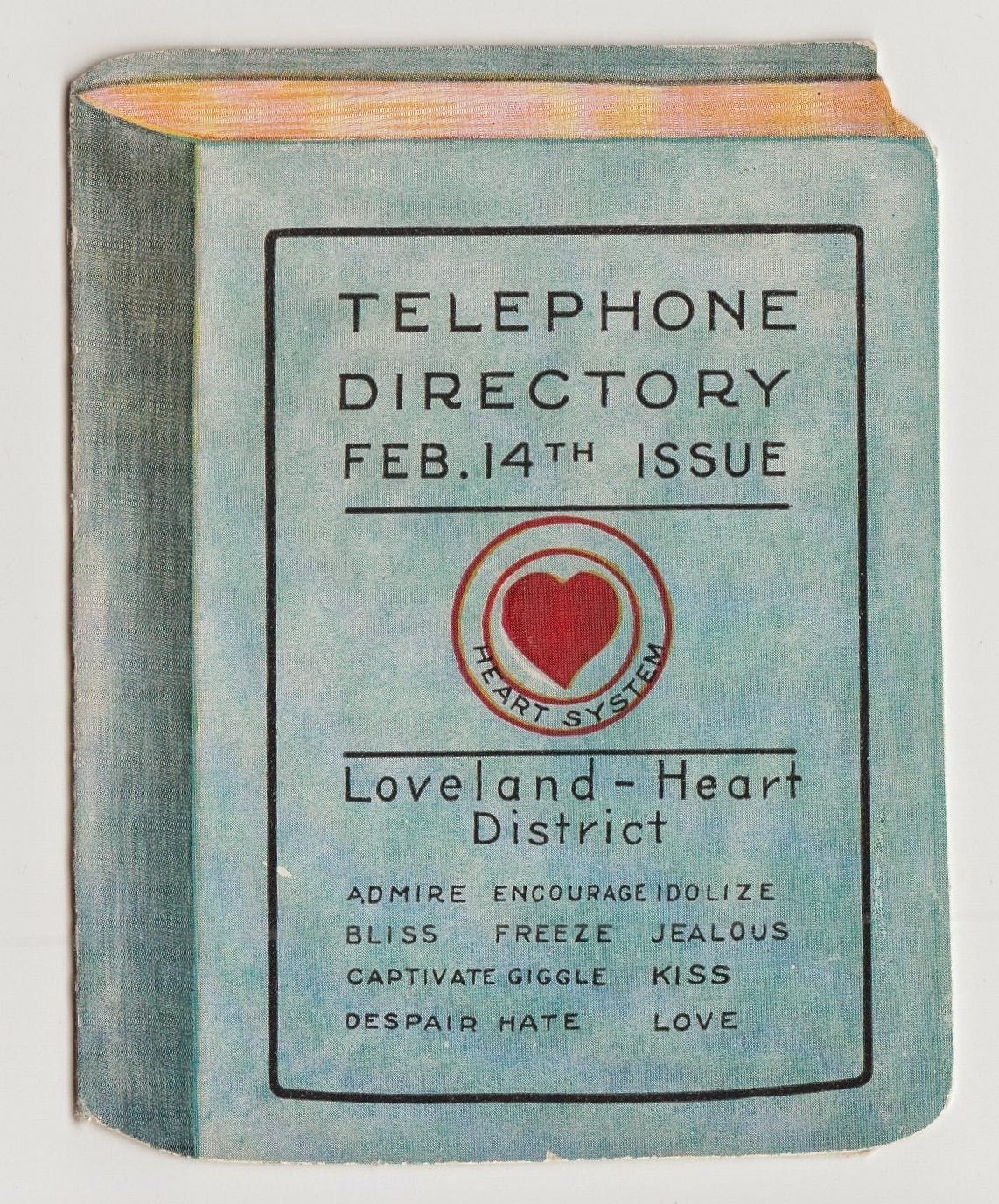
Next is a blook Valentine that is a Telephone Directory for the Loveland-Heart Disrict, in two binding variants. I like the straight-forwardness of it, with a twist of humility, and also the sub-district list of intense emotions. The promise of bliss is tempting. I might have left out hate, freeze, despair and jealous on a Valentine card. It's not very poetic and it might put the recipient in kind of a spot. 


Here it is in another binding variant. 


I like the cards that show people and objects hidden inside the book and peeping or tumbling out. His heart may be an open book, but it looks like she's got hers pretty heavily defended. I guess he has to captivate her and get her to come out of that book. 


All genres of books appear on Valentine's Day cards. I like the use of a secret code book in the one above. I'm all for clarity. 


A traditional southern belle featured on a set of romantic novels (I assume from the heards and lace), waiting for her beau to arrive. 


I Want You For My Valentine. Love can be tricky and it's best to go slowly, or know how to run fast. Watch out for predators, no matter how fuzzy or handsome they appear. I don't feel comfortable knowing that they hide in books! Does this mean the cat is smart but the mouse is notThis looks like a reference book, I hope the mouse can read.


Your Face is Like a Book postcard, by Fox. Hmn?


"Leaf" Me Be Your Valentine might be a stretch, I don't think it means anything, just a silly play on words. This indicates an unfocused or confused lover.


My Heart's An Open Book is a common sentiment or metaphor found on many blooks. Much more sincere than the fox or cat cards. I would like to be this kitty's Valentine.
 Booked to Be My Valentine feels very organized, a sign of a dependable or committed lover, it's in print after all. 


 The Sweetest Story Ever Told; You're My Valentine. Very sweet indeed. This title, or variants of it is common to blooks -- A Spicy Story, A Sweet Story and similar titles are on many Christmas candy boxes and spice sets.

Wednesday, November 12, 2014

When Books Birth Blooks: Forever Amber

In the post on how patents are useful in understanding book objects we saw how patent research can deepen our understanding of book objects. This post illustrates how magazine advertisements can do the same. Forever Amber is a 972-page romance novel set in 17th century England; written by Kathleen Winsor and published in 1944.  The book was made into an extremely popular film in 1947 by 20th Century Fox, starring the beautiful Linda Darnell (pictured on the dust jacket) and the dashing Cornell Wilde.


Above: Forever Amber in the second version of it dust jacket, in which Linda Darnell's portrait replaced another (see below).
This is stye original dust jacket design from which Forever Amber perfume was  copied. 

Forever Amber is the story of orphaned Amber St. Clare, who works her way upwards through the ranks of English society by sleeping and marrying successively richer and more important men, all the while harboring a love for a man she could never have. While there was much praise for the book at the time of publication, it was also banned in fourteen states for its blatant sexual references. Despite the banning, Forever Amber was the best-selling novel of the 1940s, selling over 100,000 copies in the first week of release and 3 million overall. The popularity of Forever Amber spun off this Forever Amber perfume in two binding variants.

Above: Forever Amber perfume, 'gift edition in fabulous gold plate.' 
Kay Daumit, 1947.

Both the gold gift edition and the Lucite gift book box can be see in the Woodward & Lothrop advertisement below. If it weren't for this ad, I may never have known that these perfume book boxes were made or who made them, nor would I know any other of the manufacturer's specifications such as their size, names, or outer packaging.
Above: Advertisement for Forever Amber perfume in two 'binding' variants. From Woodward & Lothrop, 1947.

There is more research to be done on Forever Amber, but I thought you might enjoy reading about it in process. 


Tuesday, August 19, 2014

How a Patent Can Shed Light on Blooks. Case Study, "Secrets of the American Cup"

When I first get a new blook or at the time of cataloging it, I look closely for any patent information and search for an original patent document. If the object is American, it couldn't be simpler, as these can be searched and downloaded using Google Patents. Many objects may have some version of "Patent Applied For" printed on them, but I'm fairly sure that while this was a deterrent to the theft of a design, most of these objects were never patented. Having said that, I haven't done a thorough patent search for objects in this category, so I could be wrong. 

In the case of secret book flask, Secrets of the American Cup, or, The Cause of the Controversy (Vol. 1, by Richmond B. Stoehr), the patent information was subtly blind-stamped on the interior of the top opening flap. It isn't easy to read, but shows the name if the inventor (Charles A. Brackett) and the U.S. patent date (Jan. 13, 1903). There is a detailed photograph of the stamp below. 

There are all kinds of great reasons to search for patents. What's so wonderful about them, is that you always find out something interesting about the object. Some examples of this are:
  • Some objects, as purchased, are incomplete and the patent will show you how they were originally envisioned by the inventor. 
  • You can see and read about how the object is constructed and what materials were used.
  • You find out more about the inventor, such as their gender, where they were from, what company they worked for or owned, etc.
  • You find out if there were revisions to the original design and what version of the object you have.
  • Sometimes you accidentally find a patent for an object by browsing Google Patents and this tells you that something you thought was unique, is not.
  • Some objects, such as in the case of Secrets of the American Cup, are shown in the patent as a having a slightly different function.
There are a number of blooks (as well as patented bookbinding structures) in my collection that I have found patents for. This is only one example. In this case, the patent shows that the inventor chose to illustrate this box as a candy box in the patent, although he does mention that it could be used for a bottle or flask in the text. 


Monday, July 14, 2014

The Ever-Amusing Double Blook

You must have guessed by now that I'm easily amused. One category of blooks that fill me with delight are the double blooks. By that I mean a complex object that is a book-like container which encloses one or more book-shaped objects. They are normally package designs created by companies as novelty items throughout the 20th century, as in the example below.

This Book of Perfume is a premium of Weather-Bird Shoes. I imaging that it must have been marketed through novelty catalogs and could have been printed with the name and logo of any business. It is one of many book-boxes that contain perfume, although it is unusual (but not unique) in the fact that both the bottle and package are book-shaped. As a bookbinder, I find it amusing because it depicts two very different styles of binding. The glass perfume bottle is emulating a fine binding, the type of binding that would have been bound with raised cords, full-leather and gold tooling. In contrast, the modest paper package, is a classic half-leather trade binding, the type of book that people in my experience most associate with a 'real' book.  


Book of Perfume
American, c. 1930
Probably manufactured by Cardinal Perfumes
Dubansky Collection