Showing posts with label hand bookbinding. Show all posts

Wednesday, December 31, 2014

Happy New Year!: The Gift Book Annual and the Blooks They Inspired


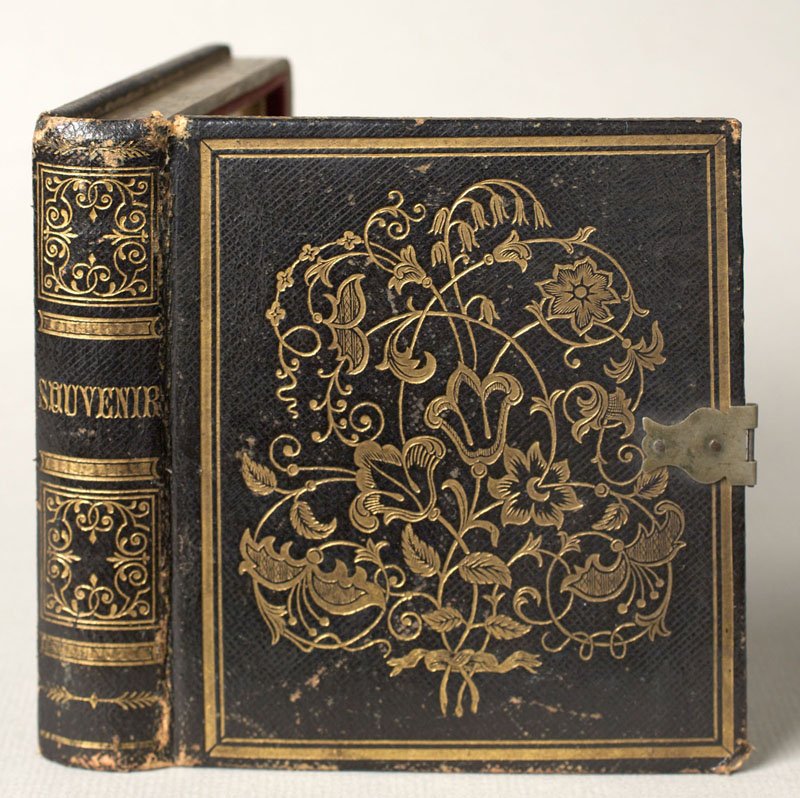
Between 1823 and 1861, lavish gift books were produced as gifts for the New Year in England and later in America. Their popularity and success as gifts for children and adults, caused a spin-off of a group of book objects made in their emulation. These objects include photograph cases, sewing kits and trinket boxes. The faux gift books were made in as many decorative binding styles and techniques as the real books. Examples are lacquer bindings, gold-tooled leather bindings, painted paper bindings and stamped cloth bindings. In general, the names of their makers are not known, but there are some exceptions.

New Year gift books had their roots in the elegant French and German almanacs and friendship books that were characterized by their beautiful bindings, a variety of contemporary literary material and high-quality steel engravings. These relatively expensive books were marketed to middle-class families and their publishers took great care to ensure that their appearance complemented the library, parlor, and boudoir. The gift books were given sentimental titles such as Friendship’s Offering, The Gem, The Token, Forget Me not, Keepsake, and Literary Souvenir. Many innovations in bookbinding technology were developed for and tested on the literary annuals. Early volumes were bound in colored, glazed paper covers, printed with decorative motifs. Later volumes were bound in silk fabric and decorative leather bindings.
Sewing Kit
The Gem
English, c. 1840
Leather, silk moiré, book board portfolio with flaps
11.6 x 6.6 x 2.0 cm (4.6 x 2.6 x 0.8 in)
Dubansky Collection

HAPPY NEW YEAR!

Wednesday, July 2, 2014

The Care and Feeding of Books, 1947

The last post featured a first-aid kit for an automobile. Here is a first-aid kit of another kind,  one for books. The Care and Feeding of Books is one of many commercial book repair kits made over the years. I'm sure you wouldn't have any trouble finding a similar new kit today. This type of kit will send chills up the spine of any book conservator because we never would want to see any of these materials in contact with books, but still it has historic interest. If you ever need a book repaired, you should call a conservator. Maybe later I will show you pictures of the (often maddening and occasionally rather amusing) destructive home book repairs that I have spent hours correcting and sometimes collect for teaching purposes. 

This octavo blook is of particular interest becasue of its bookish aesthetic and use of real bookbinding materials. Unlike other kits I have seen that are in paper boxes printed to look like books, this one could really fool you. It is a gold-tooled, quarter-sheepskin binding with plain-weave bookcloth sides. There is no maker's name on the box. Perhaps the Leather Vita company whose name is on some of the contents may have produced it -- or it could have been the brainchild of a bookbinder. The box certainly must have been manufactured in a hand bindery of some kind.


This copy of The Care and Feeding of Books is full of its original contents. They are shown below, with the exception of the book repair instruction book. The box includes a Leather Vita book entitled The Care & Feeding of Books (1944), Leather Vita leather softener, Carter’s Rytoff ink remover, a Dixon pink eraser, Dennison Transparent Mending Tape, Sanford’s Liquid Glue, a yellow sponge, a piece of white flannel, a piece of dark red flannel, and a clear plastic letter opener (probably for slitting never-opened pages).


Book Repair Kit
The Care and Feeding of Books
American, c. 1944
21.5 x 16.5 x 5.3 cm (8.5 x 6.5 x 2.1 in)
(Dubansky Collection)

I was able to find an advertisement for an earlier repair kit in another binding variant, a fine leather binding. The ad copy indicates that the kit was specifically designed to stand between real books on a book shelf. Here it is in Popular Science, March 1942, Volume 40, Number 3,  page 71: