Showing posts with label faux book. Show all posts

Sunday, April 5, 2015

Blook Game Boards

I was surprised to come across this English book (1903) that depicts a book-shaped game board on its cover (see the lower left corner). While I haven't seen other titles from the Club Series and I don't know how many titles were included, I'm assuming that this was a popular game book series and that this binding design appears on all of its titles. It's the first time I've seen a blook as an illustration. Its prominent presence on the cover is obviously an indication of how familiar people must have been with book-like game boards at the turn of the twentieth century. 


Perhaps you have seen book boards in antique shops and flea markets. There are still quite a few about today, although many are worn and damaged from years of use and the degradation of materials. They often have catchy titles, I have one named Evening Pastimes, Vols. 1 and 2. Once again the book form is a perfect vehicle for a container, adding interest and style to whatever it is applied. 

Book game boards from this period (late 19th-early 20th centuries) are usually for the games of chess, checkers and backgammon. On the board above you can see what an example of a two-volume game boards for chess, checkers and backgammon look like. This is one of many different variations. With its gold-tooled leather binding, it could easily be mistaken for real books if it was placed on a bookshelf. I have also seen the boards covered in paper, printed in chromolithography and in rustic handmade versions carved from wood. 


This is a similar board, but a less expensive version, covered in printed paper (chromolithography), rather than leather. The title is  Life of Hoyle, in two volumes. It is most probably a play on the popular book Hoyle's Rules for Playing Fashionable Games, published in many editions since the late eighteenth century. 


GO BANG!:


The Games of Go Bang, Tivoli and Fox and Geese is another example of a book game board, less common than the chess/checkers/backgammon version. I have a copy in black but you can see here that it was also made in a dark red paper version. You can see it in person if you attend my exhibition next winter at the Grolier Club. 

I hope you will all send pictures and descriptions of similar boards or other titles from the Club Series that you may see or have. Many games and puzzle containers are still made in book form today, it's an abiding tradition that has lasted more than two centuries. For an example of an even older book game box, see this post about the Heckman collection.


Thursday, February 12, 2015

Max Gunawan and the Lumio Book Light


If there is a hero of the modern blook, it's Max Gunawan, inventor of the Lumio book light and Mini Lumio+. It would be hard to imagine a more elegant blook or a more engaging man. Lumio is a rechargeable LED light with about a long-lasting battery. Its covers are wood and magnets are embedded in the covers so that the 'book' can be attached to metal surfaces. The interior 'pages' are made of Tyvek. The Lumio book light is in octavo format. I asked Max why he made it that size and he said, it just felt right. That's bookness for you. Soon, the mini-Lumio book light will be out. It's a pocket-sized version modeled on a Moleskin notebook, which is a book that Max is familiar with and has enjoyed using.  The Mini+has a removable, magnetized spine that hides a convenient phone charger. You can read all about Max and the lamps on the Hellolumio website


Max has had an interesting and inspiring journey and it's been a great success. It wasn't long ago that Max quit his job in an architect's office to follow his dream of designing and manufacturing useful, simple and beautiful objects for us all to enjoy. Since then he has had  a successful Kickstarter campaign, created TED talks, gotten financing through appearing on the TV show Shark Tank, and is selling the lamps in many Museum shops. I recently contacted Max to ask if he would consider contributing a lamp so that I could show it with it's historical precedents in my upcoming exhibition. He generously agreed and came in person to deliver and demonstrate it to the delight of the book conservation staff. If you want to read more about his journey, follow the links in this post.


Here's a few links about Max and Lumio:

Max's TED talk:


Shark Tank video:


Interview with Max: http://inhabitat.com/interview-we-talk-to-lumio-folding-book-lamp-creator-max-gunawan/


Monday, January 12, 2015

Save the Date for a Grolier Club Exhibition "The Art of Books That Aren't"

Book padlock, German or French. Late 19th or early 20th century.
This is the only book lock I have seen in all the years of collecting, have you seen others? Fortunately it does still have its key.  
Save the date for the first exhibition of my book object collection, titled The Art of Books That Aren't: January 28 through March 12, 2016. Note that this is next year, but work has begun. I've been busy rounding out the collection, writing labels, conserving the objects and photographing them. My goal is to have a catalog and I will be writing to you later about it when it has taken shape. There will also be a special event (panel or symposium), in addition to a curator chat(s). If you are interested in planning events or workshops relating to this exhibition or in publishing an announcement of it, please let me know.

Someone made this tiny Bible box for Geneva LaToer in 1853, when she was 10 years old. The box pivots out from one corner and I'd say it was backwards, as the cross only appears on the back of the box. It's rare to find these humble folk art boxes with inscrptions. There are many book objects made for children and many specifically employed in educating them in the Bible. There will be others in the exhibition. See this earlier post.
Support has been coming in many ways even before asking, so that's reassuring. I've received several wonderful donations of objects, a little donation of funds from a friend and an offer from Roni Gross to design the catalog. My photographer friends at the Met are training me to take better photographs, Stan Pinkwas contributed the title of the exhibition, my neighbor Pamela Morin drove all of my blooks to NYC from upstate, Aaron Salik at Talas has offered to provide refreshments at a special event and young magician Francis Karagodins will work on learning how to perform the book magic props! It will definitely take a village to get the blooks exhibit and events to fruition, so THANK YOU to all of you who have supported me now, in the past and into the future. It's not a simple thing to present and legitimize this wonderful subject, but we will have fun doing it.

Note: Many others have generously contributed in so many ways. Everyone will be thanked on the Blook Club page of this blog in upcoming weeks.


Tuesday, July 29, 2014

Guest Post: Spruce Boxes from Bruce and Lynn Heckman

Bruce and Lynn Heckman

This past Sunday, I had the pleasure of visiting Bruce and Lynn Heckman to see their remarkable collection of over 1,000 unique, folk art book objects. This is certainly the largest collection of its kind, certainly larger than mine which is only a little over 500. I was expecting to see a substantial collection of unique objects, but I was amazed by the breath and beauty of the collection, the extended show-and-tell viewing and the enthusiastic reception that Lynn and Bruce gave me. I’m not sure I have yet digested what I have seen, but I don’t think I will ever forget the wonderful, inspiring day I had with them. I think I'll make another post later to show a few of the blooks I took photos of that particularly interested me.


One of many shelves of book-boxes in the Heckman's collection
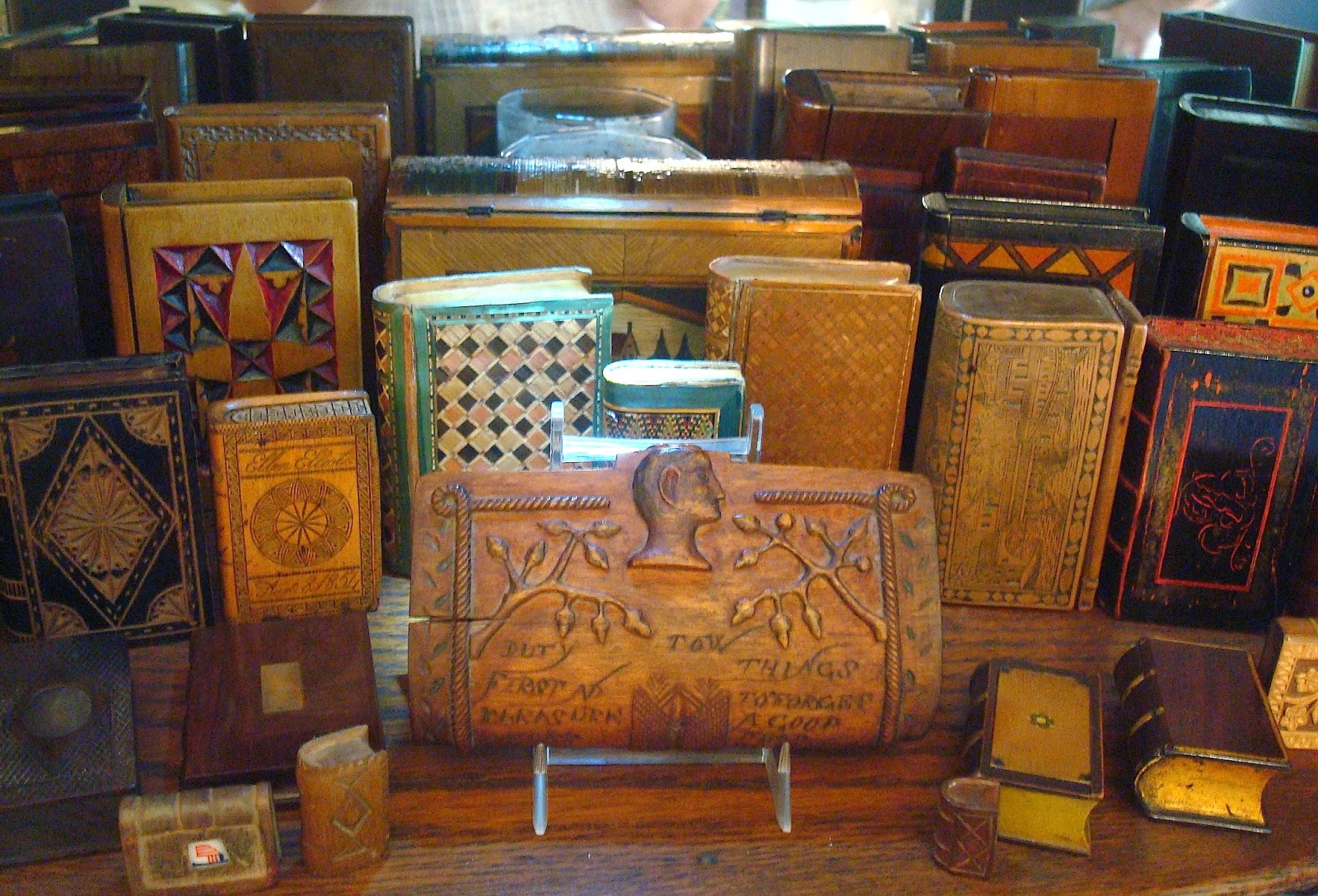
Lynn and Bruce collect as a team and the joy they share in collecting is reflected in the picture of them holding a large book box. They collect many types of book objects, but the largest single category, from a media perspective, is that of  carved wooden boxes with various functions, made during the 18th through 20th centuries. Sewing boxes, puzzle boxes, snake boxes, love-gift boxes, solid carved books, Civil War lancet boxes, banks and safes were all represented; however, the most prominent group within the wooden boxes were the charming American and Canadian spruce gum boxes. Bruce and Lynn provided this post for us so that we can learn more about the history of the spruce gum book box:

Spruce Gum Boxes in the Form of Books
by Bruce and Lynn Heckman


Spruce gum boxes are manifestations of the same impulses that drive the creation of much Folk Art:  Love, moral fervor, whimsy, loneliness due to isolation, and an excessive availability of time. The chewing of gum has been going on for 5000 years, since Neolithic times.  Spruce gum was excreted by trees in the North Woods of Canada and the U.S. and harvested by lumbermen to put in boxes to bring home to loved ones for their chewing  enjoyment. Carving of the boxes spans the 1870's to the 1920's, though some modern examples exist. Modern boxes have a lack of patina that cries out to you after you've handled enough boxes.  We think that some boxes with patriotic were produced for the American Centennial of 1876.


Books were the models for almost all spruce gum boxes, though many were made in the form of a barrel. Bookishness is not normally associated with the lumbermen of the North Woods, but the book icon was widely adapted.  The book-shaped boxes appeal from the tactile, visual, and historical points of view.  Most fit nicely in the hand and were about five inches tall, although some are as small as two and one-half inches and as tall as thirteen inches. Carving varies from the simple to the very intricate. Paint and stains are used, as well as photographs, applied hearts, mirrors, found objects, and colored beeswax. Some boxes have the names of people and places, dates, and sentimental expressions.


Time was abundant in the North Woods and, after a day of felling trees, the nights were occupied with box carving.  The design was made, the piece of wood hollowed out from both ends, and slides were made for the top and bottom.  The decoration was carved and applied and the boxes sealed with shellac.  The heart was the most common decoration and signifies that these objects were created for loved ones at home.  Extensive chip carving was used.  Anchors, ropes, stars, crosses, tree of life, and geometric shapes were incised or applied.


We have been collecting spruce gum boxes since July 1989. Since then, our collection has grown to approximately one hundred boxes. These are part of a much larger collection of 'blooks' spanning three centuries and many countries. The spruce gum boxes appeal to us for their artistic, sentimental, and historical aspects.  We have enjoyed the collecting hunt and sharing our collection with interested collectors.


_______

Record Image
Maine State Museum Collection
If readers would like to see and learn more about spruce boxes, the Maine State Museum has very good images and descriptions of the boxes on their online website.

Click here to read an article about spruce gum from Northern Woodlands Magazine.  

Ian Berke recently sent this picture of three source gum boxes he recently saw at the
Maine State Museum.


Friday, July 4, 2014

Introducing the Book Camera

Since it's July 4 and you will all have your smart phones out documenting everything in sight, I thought it would be a nice day to reflect on the blookish predecessors of the camera. 

Older book objects that fit into the theme of photography are ingenious, elegant, well-made and of great historical significance. They were made over a long period of time and are still being made today, but newer ones are not always so fine.  This genre of blooks includes book cameras, daguerreotype cases, security devices, book safes, lockets, view finders, photograph storage containers and more. 

Book cameras evolved from the late 1880's and throughout the 1890's, as detective or concealed novelty cameras (even earlier if you consider the camera obscura, some of which were made in book form). I don't think that they could have really fooled anyone when they were in use, as the photographer's posture must have been awkward in comparison to an actual scholar rushing to or from the library; it would be nice to see one in use. In most cases, great pains were taken by the manufacturers to create a realistic impression. This is especially true in the case of the Scovill book camera featured below. This camera is made to appear like a parcel of three nicely bound books, in full-leather bindings and gold-tooled leather title labels -- French, Latin and  Shadows. Book cameras were produced internationally in the late 19th century, by a number of manufacturers in numerous single and multi-book formats. I'll show you one of each below.  

This unusual camera is in the collection of the Swiss Camera Museum.


Book Camera with a Flash. Revolver Photogénique.
French. Dr. Ranque. 1890

To the best of my ability I will explain this camera. The Revolver Photogénique is a detective or concealed book camera that produced its own light source in order to better capture movement. By actuating a pull-tab on the side of the camera, a dose of magnesium powder  was dropped into a reservoir. The powder was then channeled to the flame of an alcohol lamp (cylinder side), controlled by a damper.

Here is an engraved image in an advertisement showing it with it's squeeze bulb and an interior view. This image is from a website that suggests that this camera was also a gun. I do have another toy book spy camera in my collection that shoots three plastic bullets, but the Revolver Photogéniqe is not an armed weapon, although it could be dangerous.

Image from Weirdest Cameras of the 1890s. 


Seen below, with an advertisement that sheds light on its context, is Scovill's Book Camera (American), introduced in 1892. From the advertisement, we see that the book camera was marketed to ladies as well as gentleman, that it was relatively light and compact, and that its book-disguise avoided the then-common adverse reaction of the public to the common box camera. Isn't it difficult to imagine a time when hand cameras were universally avoided by the public? How we have changed! If you would like to see the Scovill camera in person, there is one on display in the George Eastman House, in Rochester, New York.


Just to give you an example of a newer book camera, here are two from my collecton. A Russian children's book, made in Japan and The Secret Sam Spy Dictionary Camera that shoots three plastic bullets (I love books that have extra jobs to do). 


Happy July 4!

Wednesday, July 2, 2014

The Care and Feeding of Books, 1947

The last post featured a first-aid kit for an automobile. Here is a first-aid kit of another kind,  one for books. The Care and Feeding of Books is one of many commercial book repair kits made over the years. I'm sure you wouldn't have any trouble finding a similar new kit today. This type of kit will send chills up the spine of any book conservator because we never would want to see any of these materials in contact with books, but still it has historic interest. If you ever need a book repaired, you should call a conservator. Maybe later I will show you pictures of the (often maddening and occasionally rather amusing) destructive home book repairs that I have spent hours correcting and sometimes collect for teaching purposes. 

This octavo blook is of particular interest becasue of its bookish aesthetic and use of real bookbinding materials. Unlike other kits I have seen that are in paper boxes printed to look like books, this one could really fool you. It is a gold-tooled, quarter-sheepskin binding with plain-weave bookcloth sides. There is no maker's name on the box. Perhaps the Leather Vita company whose name is on some of the contents may have produced it -- or it could have been the brainchild of a bookbinder. The box certainly must have been manufactured in a hand bindery of some kind.


This copy of The Care and Feeding of Books is full of its original contents. They are shown below, with the exception of the book repair instruction book. The box includes a Leather Vita book entitled The Care & Feeding of Books (1944), Leather Vita leather softener, Carter’s Rytoff ink remover, a Dixon pink eraser, Dennison Transparent Mending Tape, Sanford’s Liquid Glue, a yellow sponge, a piece of white flannel, a piece of dark red flannel, and a clear plastic letter opener (probably for slitting never-opened pages).


Book Repair Kit
The Care and Feeding of Books
American, c. 1944
21.5 x 16.5 x 5.3 cm (8.5 x 6.5 x 2.1 in)
(Dubansky Collection)

I was able to find an advertisement for an earlier repair kit in another binding variant, a fine leather binding. The ad copy indicates that the kit was specifically designed to stand between real books on a book shelf. Here it is in Popular Science, March 1942, Volume 40, Number 3,  page 71:


Monday, June 23, 2014

Whitman's Library Package (and I don't mean Walt)

The book format has been internationally popular as a novelty container for many types of candy since at least the late 20th century and probably earlier. One of my favorites is the Whitman's Library Package. In this ad dated 1922, it is referred to by the unfortunate term 'Oddity'. While there are many book-like candy boxes, not many follow through with the theme, as this one does, by providing a Table of Contents and a publisher's list of other titles. The Whitman's Library Package is bound in paper, printed to emulate a full-leather (goatskin) binding with gold tooling. I don't believe it was issued in other binding variants.  


I look forward to showing you other candy blooks in the future, but while we are on the subject I thought that you might enjoy this excerpt from a post that I found today on a site entitled Candy Professor:
...High-quality candy novelties were much more important in the early days of the candy industry. Success in the candy business hinged on moving quickly to introduce new kinds of candy and new novelties to catch the eye of child or adult shopper. Higher priced candy was often bought as a gift, and clever or eye catching presentations would increase a gift’s value. For children’s candies, the novelty could transform a simple candy into something much more appealing.
These candy dolls from the 1920s were manufactured by Huyler’s, a large confectioner better known for quality chocolates. Although these goods are for children, they would have been sold at higher-priced shops and department stores alongside Huyler’s chocolate goods and similar candies. Each was made by hand. These candy dolls appear primitive to the modern eye, but must have been charming and appealing to a child in the 1920s...
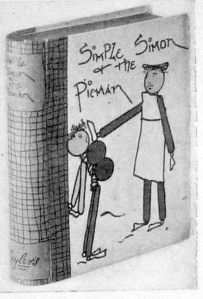
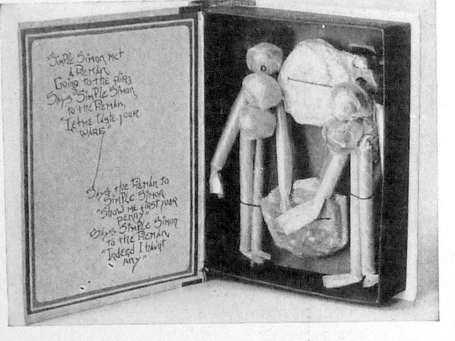
...Here is Simple Simon, fashioned of candy sticks, with his chocolate pies.  The book motif is cleverly carried through from the shape of the box to the hand-written rhyme, with the figures and candies playing out the theme.
In the Simple Simon package, the Huyler’s name is featured prominently. The transformation of candy box into part of a toy novelty assures that the manufacturer’s name stays in the child’s mind. The novelties are not only for children’s delight, but also to build business:
The children of today are the candy buyers of the future. [These novelties] give the manufacturer a chance to get first place in the child’s affections.
Source: Edward T. Tandy, “Place of Novelties in Merchandising,” Confectioners Journal April 1921 (Printers Ink March 1921)

Thursday, June 19, 2014

Hoo Doo That Voo Doo That You Do So Well?


This post features another object from the collection of The Metropolitan Museum of Art (American Decorative Arts) and fortunately, this one is on view for all to see. (The last MMA object posted was the Book Harmonium.) The object record from the Museum's website is below. I'm slightly embarrassed that they don't include the title in the catalog entry, because by some, that could be considered the best part and standard book cataloging practice - especially in this case, as this is one powerful blook! Let me introduce the Hoo Doo Bible in the form of a Bennington Book Flask:

Book flask
United States Pottery Company 
(1852–58)
Date: 1849
Geography: New England, Bennington, Vermont, United States
Culture: American
Medium: Mottled brown earthenware
Dimensions: H. 6 in. (15.2 cm)
Classification: Ceramics
Credit Line: Gift of Mrs. Stanley Herzman, 1984
Accession Number: 1984.395.12
On view in gallery 774

Bennington book flasks have been widely collected and published. They were popular novelty items made in both Rockingham and flint enamel, in many sizes. They frequently have titles impressed on the spine such as: Battle of Bennington, Bennington Ladies, Hermit’s Delight, Suffering and Death, Departed Spirits, Life of Kossuth and many others. All are hefty books with round spines with raised cords, corresponding concave foredges, squares, lines indicating pages on the edges. Some have more details than others, including endbands and tooled lines.