Showing posts with label book collecting. Show all posts

Sunday, October 16, 2016

Come Meet Me at the Boston Book Fair

Hello Blook-lovers! I hope to see some of you at this Ticknor Society event in Boston. I'll be happy to sign your books, but I won't be carrying many. If you would like one, please order through this website. If you want to give them as holiday gifts I'm offering a 40% discount for 5 or more copies. Email me at mindelldubansky@gmail.com. See you soon!

Collectors Roundtable: Librarians Who Collect
Saturday, October 29, 2016, 3PM
International Book Fair, Hynes Convention Center
(Come and visit us at booth 625!)


The Ticknor Society's Collectors Roundtable at the International Book Fair this year will be hosted by Beth Carroll-Horrocks at 3PM, and will feature speakers who are librarians, or who work in libraries, and who have interesting collections outside of their institutional holdings.
Mindell Dubansky (The Metropolitan Museum of Art) will talk about her collection of blooks (objects that look like books but aren't books).
Christian Dupont (Boston College) and Silvia Dupont (Newton North High School) collect Italian grammar books from the mid-18th to mid-19th century that were published for French speakers who wanted to learn the language and literature of Italy.
Joshua Lupkin (Harvard University) will describe a collection he stewarded at his previous job (at Tulane University), using an endowment for buying books about cats and dogs, and how he continues to build interest in the collection through social media.

Wednesday, July 13, 2016

The Curious Genre of Maple Sugar Bible Molds


Before the availability of refrigeration which made maple syrup a viable commodity, maple products were produced in solid forms such as maple sugar. Maple sugar was often processed in decorative wooden molds as sale or gift items. Sugar molds were made during the 19th century throughout New England and Canada. I have found a curious group of bible molds which produced small sugar bibles that would fit in your hand. I have seen these in three different designs and assembly styles. Two are in my collection and one is at the Royal Ontario Museum. I don't really have an understanding yet of the context of the maple sugar bibles, but they could have been served at religious communal meals and holidays, or perhaps they were gifts or rewards for children.


Mold 1: This mold was purchased from a dealer in Maine. It probably dates from the late 19th century. It is missing it's foredge piece. In the shipping box there was an additional spine piece, indicating that there were at least two book molds. This is a six-piece mold held together with four wood pegs. Only two are shown. Its bookish features include a curved spine with three raised bands, squares, and a cross design typical of a bookbinding. The mold is fully described in my book Blooks: The Art of Books That Aren't. To understand more about the history and production of maple sugar, I refer you to the essay Maple History, from the website of the Massachusetts Maple Producers Association. Here is a segment:
From the journals of early New England explorers we have learned that there were three types of maple sugar made by the Northeastern American Indians: "Grain Sugar" a coarse granulated sugar similar to that we know as "brown sugar"; "Cake Sugar," sugar poured into wooden molds to become hard cakes or blocks; and "Wax Sugar," which was made by boiling syrup extra thick and pouring it over snow. This wax sugar is what we know today as "sugar on snow."
In the early days maple sap was boiled down and made into maple sugar, instead of the more common maple syrup that we see today. There was no easy way to store syrup as a liquid, but hardened, dry maple sugar was easily stored for use later in the year. The Native Americans of New England used their maple sugar as gifts, for trading, to mix with grains and berries and bear fat. During the heat of summer a special treat was a drink made of maple sugar dissolved in water. The early European settlers who came to New England made maple sugar in the way which they learned from the Native Indian population. The settlers set up sugar camps in the woods where the maple trees were most plentiful, and the trees were slashed with an ax to allow the sap to drip out and be collected. As early as 1790 it was suggested that. slashing the trees was not good for their health, and that a better way was to drill a half inch hole in the tree and insert a "spill" or spile to allow the sap to run out. The early spiles were made of a softwood twig such as sumac that had a soft center. The center was pushed out leaving a hollow wooden tube that could be inserted into a hole drilled into the maple tree. The sap would then drip out through the hollow tube or "spile", and into a collection vessel such as a hollowed out log.
These early sugarmakers gathered their sap in wooden buckets as they went from tree to tree. The sap was then boiled down in a series of large iron kettles hanging over a long open fire. As the syrup got thicker in one kettle it was ladled into the next one and fresh sap was then added to the first kettle. In this way, they always had the last kettle full of nearly completed syrup or sugar. When it was finally thickened enough, the liquid sugar was stirred until it began to crystallize, then poured of into wooden molds. These blocks of maple sugar could be broken up or shaved later in the year when needed. (continued below)
Mold 2: Below is another mold from my collection. Instead of pegs, it uses two wood clamps to lock the pieces for pouring. Notice that the top piece, which represents the foredge of the bible is upside down in this photograph. This mold revealed something new to me about bible molds and their usage. 


What I thought in the sales photographs were raised bands, turned out to be the letters RIP (Rest In Peace), indicating that this mold could have been used in relation to a funeral gathering. 


Below is a detail, showing a registration mark at the right:


The registration mark, which looks like an "A" shows the sugar maker how to assemble the pieces of the mold. 


Mold 3: This elaborate and apparently well-used bible mold shown below resides in the collection of the Royal Ontario Museum, Canada. The bible design is a bit more formal than the other molds and the maker seems more skilled. The spine is flat. Notice the heavy corners. I'm not sure how it was locked, but there could be clamps missing or perhaps it was held shut with hand pressure alone. 


This sweet product of the New England forests was very important to the colonists of early Massachusetts. In addition to providing a homemade source of sugar, the maple sugar was also used for trade or was sold. Many colonists made far more maple sugar than they could use themselves, sometimes as much as a thousand pounds per family. This excess was valuable to the early settlers as it provided some income or could be traded at local stores for other food and supplies. This locally made sugar was also important to the New Englanders because it was a sugar not made by the slaves of the West Indies. Our third President, Thomas Jefferson, was so much in favor of the United States producing its own maple sugar that he even started a plantation of sugar maples at his home, Monticello.
Over the next hundred years or so, maple sugar producing went through some changes. Metal buckets replaced the wooden ones; metal tanks became available for sap storage instead of hollowed out logs or wooden barrels. For boiling, large flat pans soon replaced the three open kettles that were hung over an open fire. A contained fire could be built under the flat pan in a furnace or "arch", thus becoming more efficient because of the large surface area exposed to the fire. Other improvements included the building of shelters for boiling the sap, which became know as "sugarhouses." However, the process still involved much time and labor.
As the price of imported cane sugar declined, more New Englanders bought cane sugar instead of maple sugar. By the late 1800's a Vermont man built what he called a Maple sugar "evaporator." This especially designed flat pan had channels for the sap to flow through as it boiled. In this way fresh sap could always be added to one end of the evaporator, and finished syrup could be drawn off at the other end. Today pure maple syrup is still made in an evaporator with much the same design.
Shortly before 1890 the import tax on white cane sugar was removed, and cane sugar soon out sold maple sugar. What happened in the maple industry however, was that maple syrup became popular. Soon the New England "sugarmakers" were making maple syrup instead of maple sugar, and were selling it in cans and bottles. Now over a century later we still seek that special flavor of pure maple syrup that the original settlers of Massachusetts learned about from the Native Americans.

What I don't know about these molds could fill a book. I'd like to know their dates, who made them, where exactly they were made and how they were used. I've read that Quakers supported maple sugar before the Civil War to boycott the use of cane sugar which was produced by slaves, but I don't know if these molds were produced that early. If you have any insight into the molds of have photos of other bible molds, I'd like to hear from you. In the meantime, I'll continue the search and update the blog post if I find new information. 


Wednesday, June 29, 2016

The Fantasy World of Story Book Villages

Hello again readers! Since the end of my blooks exhibition I haven't written much on the blog. I thank those of you who have noticed my absence and I am now beginning again by completing some of the blog posts I've had in draft form. I begin with a post on blooks associated with a group of American children's theme parks, or story book villages, some long gone and others still in operation. If you visit them, send pictures!

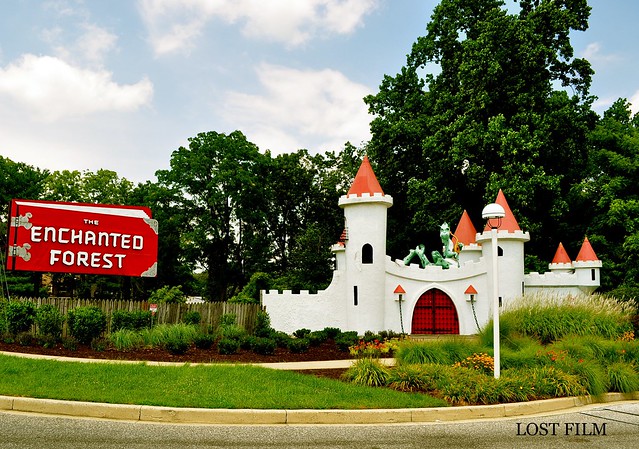
To me, some of the most interesting and affecting blooks are large and ephemeral. These include billboards, signs and stage props. But what could be more exciting than passing through a giant story book into a magical world? As a small child, I had that experience growing up in Baltimore, which was near the Enchanted Forest in Ellicott City, Maryland.

The Enchanted Forest. Ellicott City, Maryland


The Enchanted Forest was the first theme park on the East Coast and the second oldest in the USA (Disneyland is the oldest). It opened on August 15, 1955.  The Enchanted Forest was meant for the small children who were intimately familiar with Mother Goose and other fairy tales. It featured no mechanical rides or spectacular special effects, but was full of wonderful giant interactive sculptures that were illustrations of the familiar tales, such as the Old Woman Who Live in a Shoe. In its heyday, the Enchanted Forest hosted some 300,000 visitors annually. Admission was $1 for adults and 50¢ for children. The park began on 20 acres, expanded to 52 acres and later reduced to 32 acres. The park closed in 1988, when its owners sold the property to develop a Shopping Center.

After closing, Clark's Elioak Farm purchased and re-installed many of the original Enchanted Forest features. You can visit them still! See http://clarklandfarm.com/.

Story Book Forest. Ligonier, Pennsylvania.

Where dreams are real and so are your story book friends!

Story Book Forest in Ligonier, Pa. is still in business! It is described on its website as a place where children can meet their favorite characters from nursery rhymes and children's tales and where parents and grandparents can revisit their youth and reminisce about simpler times. Story Book Forest was developed by C.C. Macdonald and Arthur Jennings, a performance clown who spent his summers entertaining guests at Idlewild Park. Working together, they made their dream a reality, and created one of the most fun and memorable things to do near Pittsburgh. Story Book Forest is a place for dreams and kids activities in Pittsburgh. 


Fantasy Land. Gettysburg, Pennsylvania.


Fantasyland was in operation from 1959 to 1980. It was owned and operated by Kenneth and Thelma Dick on 23 acres (later expanded to 35) near General Meade's Headquarters, the present National Park Service Visitors Center. Noted for its beauty, tranquility and cleanliness, the story book land provided over 100 attractions. These included an Enchanted Forest and Santa's Village, Fort Apache (which was attacked by live Indians), Rapunsel's Castle, and more.


Never Never Land, Tacoma, Washington


Never Never Land was a private attraction owned and operated by Alfred Peterson of Victoria, B. C. from 1964 to 1985. In the cool, green forest of cedar, fir and hemlock trees, where ferns and moss covered the ground, the stories of enchantment from Mother Goose to the Brothers Grimm were brought to life. 


Story Land, Glen, New Hampshire

Need a little fairy tale magic in your family’s life? Look no further than Story Land in Glen, NH. Celebrating its 58th year of providing families with young children a treasure chest of memories in New Hampshire’s beautiful White Mountains, Story Land is not your average amusement park. Geared toward children ages 2-12, Story Land provides a gentler approach to your usual family attraction.


Story Land. New Orleans, Louisiana


You can still climb aboard Captain Hook’s pirate ship, follow Pinocchio into the mouth of a whale or scamper up Jack & Jill’s Hill at Story Land in New Orlean's City Park. Fairytales and fantasy come to life before your eyes in City Park’s Storyland. This charming theme playground is a child’s dream come true, filled with 20 larger-than-life storybook sculptures featuring classic fairytale characters. - See more at: http://neworleanscitypark.com/in-the-park/storyland#sthash.jiTZGRnP.dpuf


Enchanted Forest. Turner, Oregon


In the 60's, Roger Tofte, a young father realized that there wasn't a lot for a family to see and do together in Salem. He formulated the idea for a theme park where he could use his creative talents and though he had very little time or money to make his dream a reality, he persisted anyway. He purchased the original 20 acres of land and began construction in 1964. He repaired watches in his spare time to help finance his project and worked on building the park after work and on weekends. The Tofte's own backyard became filled with storybook figures and small buildings as Roger also used every spare second at home to work on his dream.


Roger originally thought it would take only two years to build the Storybook Trail, which was the first section that he needed to complete before the park could open. Finally, after seven years Roger and his wife Mavis hung up a piece of butcher paper saying "OPEN" on the fence and the first visitors entered the park. Over the years, Roger and his family have been adding to his dream with new additions to the park. Now, Roger Tofte, though still the ringleader of Enchanted Forest, has successfully incorporated three of his children into the business. For more on this theme park see: 
http://www.roadarch.com/fairyparks/main.html
http://www.enchantedforest.com/history.html


Sunday, February 7, 2016

Judith Leiber's Book Purses


Judith Leiber
Many fabulous and not-so-fabulous designers have been creating book purses for a long time, at least since the 1890s. Judith Leiber's crystal book purses stand out as the most luxurious, numerous and varied. (Olympia Le- Tan is another book purse designer of note.) As far as I have been able to determine, Leiber designed two types of book purses, a single and a three-volume, strapped variants. I'm creating this post as a way of collecting images and information on the purses. It's a work in progress and I'll add them as I find them. Check back now and then. Here is an article on Leiber from the Jewish Women's Archive. 

This is a description from an auction sale of one of the bags:


Judith Leiber Crystal Books Minaudiere Evening Bag

5.5" Width x 3" Height x 2.5" Depth

Minaudieres by Judith Leiber are a rare blend of art and utility. Testament to the flawless craftsmanship and creativity of these minaudieres, they included in the permanent collections of prestigious institutions such as The Metropolitan Museum of Art in New York, The Victoria and Albert Museum in London, and The Houston Museum of Fine Arts. This minaudiere shaped like a stack of books is done in a plethora of colors and accented with gold hardware. The interior is done in gold metallic leather. This bag includes a coin purse, a comb, and a small dustbag.


Little Black Book is not so little.

From Saks Fifth Avenue. Sold for $4,695 (2014)


A very elegant version with faux marbled ediges


Also seen in green. This one is the most realistic of the designs seen so far.


Thursday, October 29, 2015

The 2016 Blooks Wall Calendar

I just finished this limited edition wall calendar which is the reward for a $50 donation to the Blooks: The Art of Books That Aren't exhibition and catalog. Details on ordering are found on the Grolier Club exhibition page.


Saturday, April 25, 2015

New Grolier Club exhibition page

Dear Readers, 
Please support the blook exhibition catalog and programs. I need your donations to bring them to fruition! Thank you for your readership, over 29,000 since last June.

$30,000 needed. $17,850 raised so far.


To Contribute


The Art of Books That Aren't
January 28 - March 12, 2016
Grolier Club, 2nd floor member's exhibition gallery, 47 E. 60th St. NYC

2016 is the Year of the Blook! In January you are invited to the first blook exhibition ever to be held in the U. S. and only the second in the world. You will see over 100 objects of great diversity and ephemera which puts the objects into historical perspective. The exhibition is the result of  two decades of collecting and research. I'm so looking forward to sharing this with you. In order to produce (self-publish) the catalog and programs for your enjoyment, I need to raise $30,000. I would appreciate any donation you can make and there will be perks (see below).

PAYMENT OPTIONS
Click on the payment payment button in this post and choose your option
Log into Paypal and make a Paypal payment to mindelldubansky@gmail.com
Send a personal check or money order to: Mindell Dubansky
210 East 88th Street
#4-D
New York, NY 10128

FUNDING REWARDS
$10 Your name and website link on the Blook Club page of this blog and in the exhibition catalog.

$25 Your name and website link on the Blook Club page of this blog; your name in the exhibition catalog and two handmade greeting cards, made after vintage blook cards from my collection.  

$50 Your name and website link on the Blook Club page of this blog and the 2016 Year of the Blook wall calendar. 

$100 Your name and website link on the Blook Club page of this blog  and a personalized copy of The Art of Books That Aren't catalog.

$500 All of the above plus a choice of a copy of one of my books Guess Who Died? Memories of Baltimore with Recipes or The Proper Decoration of Book Covers: The Life and Work of Alice C. Morse; or an original felt flower pin by myself made to your specifications; or another perk that we can work out together. 

$1,000 A copy of The Art of Books That Aren't catalog and a unique book-lovers tours of the Metropolitan Museum of Art with me as your tour guide; or a private tour of the Grolier exhibition. Includes mentions on the Blook Club page and in the catalog. 

DONORS: to know more about the over 130 contributors to this project, see the Blook Club page of this blog.

CATALOG: EARLY BIRD SUBSCRIPTIONS
To subscribe to the Art of Books That Aren't catalog, please send your name and contact information. I will post the final price and specs to the exhibition page and email you as soon as I have them. The Art of Books That Aren't will be a paperback book,  9 x 11 inches, about 100 pages with about 150 color illustrations. I am on schedule now to have the book ready by mid-January 2016.

PROGRAMS
There will be at least one symposium with speakers who are collectors, historians and makers of book objects. I am also planning a magic show with book effects and weekly public gallery talks. Please let me know if you would like to plan a private tour or lecture.

FOR MORE INFORMATION CONTACT 

mindelldubansky@gmail.com
Daytime: 212-650-2890
Evening: 212-348-1674