Showing posts with label blook. Show all posts

Wednesday, June 29, 2016

Video of the Grolier Club Colloquium: Blooks: The Art of Books That Aren't

On February 2, Columbia University and the Grolier Club sponsored an evening colloquium in conjunction with my exhibition Blooks: The Art of Books That Aren't. The symposium was filmed and the film is available on the Grolier Club website.


Here is a link: https://vimeo.com/158427834


Here is the program of speakers:


Colloquium in conjunction with the exhibition

Blooks: The Art of Books That Aren’t

January 28-March 12, 2016
 
Sponsored by Columbia University and the Grolier Club

Tuesday, February 2
Hours: 6:00-8:00 PM
 
Program

Moderator, Karla Nielsen, Ph. D., MSLIS. Curator of Literature. Rare Book and Manuscript Library, Columbia University

The Larger View of Blooks
Mindell Dubansky
Museum Librarian - Preservation, The Sherman Fairchild Center for Book Conservation, Thomas J. Watson Library, The Metropolitan Museum of Art

 Collecting Antiquarian Book Objects
Private collecting team, Bruce and Lynn Heckman

The Book as Object
Lynn Festa
Associate Professor of English. Department of English, Rutgers University.

Panel Discussion and Questions. Reception.


Thursday, October 29, 2015

The 2016 Blooks Wall Calendar

I just finished this limited edition wall calendar which is the reward for a $50 donation to the Blooks: The Art of Books That Aren't exhibition and catalog. Details on ordering are found on the Grolier Club exhibition page.


Sunday, April 5, 2015

Blook Game Boards

I was surprised to come across this English book (1903) that depicts a book-shaped game board on its cover (see the lower left corner). While I haven't seen other titles from the Club Series and I don't know how many titles were included, I'm assuming that this was a popular game book series and that this binding design appears on all of its titles. It's the first time I've seen a blook as an illustration. Its prominent presence on the cover is obviously an indication of how familiar people must have been with book-like game boards at the turn of the twentieth century. 


Perhaps you have seen book boards in antique shops and flea markets. There are still quite a few about today, although many are worn and damaged from years of use and the degradation of materials. They often have catchy titles, I have one named Evening Pastimes, Vols. 1 and 2. Once again the book form is a perfect vehicle for a container, adding interest and style to whatever it is applied. 

Book game boards from this period (late 19th-early 20th centuries) are usually for the games of chess, checkers and backgammon. On the board above you can see what an example of a two-volume game boards for chess, checkers and backgammon look like. This is one of many different variations. With its gold-tooled leather binding, it could easily be mistaken for real books if it was placed on a bookshelf. I have also seen the boards covered in paper, printed in chromolithography and in rustic handmade versions carved from wood. 


This is a similar board, but a less expensive version, covered in printed paper (chromolithography), rather than leather. The title is  Life of Hoyle, in two volumes. It is most probably a play on the popular book Hoyle's Rules for Playing Fashionable Games, published in many editions since the late eighteenth century. 


GO BANG!:


The Games of Go Bang, Tivoli and Fox and Geese is another example of a book game board, less common than the chess/checkers/backgammon version. I have a copy in black but you can see here that it was also made in a dark red paper version. You can see it in person if you attend my exhibition next winter at the Grolier Club. 

I hope you will all send pictures and descriptions of similar boards or other titles from the Club Series that you may see or have. Many games and puzzle containers are still made in book form today, it's an abiding tradition that has lasted more than two centuries. For an example of an even older book game box, see this post about the Heckman collection.


Monday, February 9, 2015

Loving Blookish Valentines Day Thoughts

Dear Readers, 
I think that you are my Valentines this year. Love to YOU! 

Maybe these blookish Valentine's Day cards will inspire you to make Valentine cards or artist's books in time for the big day.

There are book-shaped greeting cards for many occasions, but since we are on the brink of Valentine's Day it's appropriate to show a variety of images of vintage cards that I found over the last year and encourage you to explore love and the book. 

The foredge clasp makes Love to My Teacher appear to be a diary with a strangely narrow spine. I can see having given this to my first grade teacher Miss Alice Schill, who was very loving. I don't think I ever got in trouble for talking too much in her class. She always remembered me, even through high school. It makes me think of her now. 

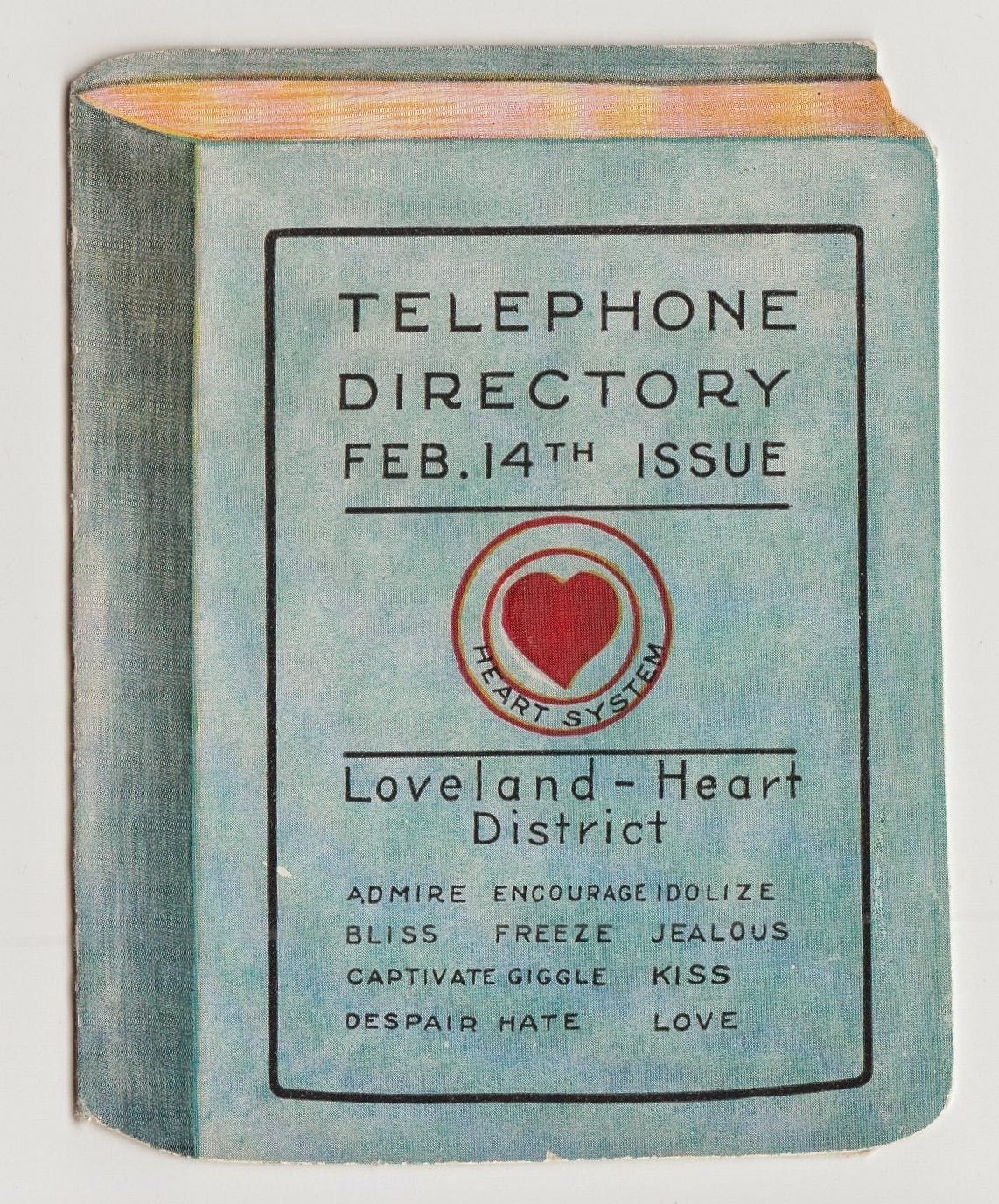
Next is a blook Valentine that is a Telephone Directory for the Loveland-Heart Disrict, in two binding variants. I like the straight-forwardness of it, with a twist of humility, and also the sub-district list of intense emotions. The promise of bliss is tempting. I might have left out hate, freeze, despair and jealous on a Valentine card. It's not very poetic and it might put the recipient in kind of a spot. 


Here it is in another binding variant. 


I like the cards that show people and objects hidden inside the book and peeping or tumbling out. His heart may be an open book, but it looks like she's got hers pretty heavily defended. I guess he has to captivate her and get her to come out of that book. 


All genres of books appear on Valentine's Day cards. I like the use of a secret code book in the one above. I'm all for clarity. 


A traditional southern belle featured on a set of romantic novels (I assume from the heards and lace), waiting for her beau to arrive. 


I Want You For My Valentine. Love can be tricky and it's best to go slowly, or know how to run fast. Watch out for predators, no matter how fuzzy or handsome they appear. I don't feel comfortable knowing that they hide in books! Does this mean the cat is smart but the mouse is notThis looks like a reference book, I hope the mouse can read.


Your Face is Like a Book postcard, by Fox. Hmn?


"Leaf" Me Be Your Valentine might be a stretch, I don't think it means anything, just a silly play on words. This indicates an unfocused or confused lover.


My Heart's An Open Book is a common sentiment or metaphor found on many blooks. Much more sincere than the fox or cat cards. I would like to be this kitty's Valentine.
 Booked to Be My Valentine feels very organized, a sign of a dependable or committed lover, it's in print after all. 


 The Sweetest Story Ever Told; You're My Valentine. Very sweet indeed. This title, or variants of it is common to blooks -- A Spicy Story, A Sweet Story and similar titles are on many Christmas candy boxes and spice sets.

Monday, October 20, 2014

An Alarming Hybrid. An Exploding Publishers' Binding


Exploding book. Kelco Loud Book: A Great Warning to You on Preparedness. Wake Up. An Alarming Report. Designed and sold by John J. Reinhold, Marietta, Pa. American. c. 1912.
Stamped cloth publisher's binding, binders waste, metal trap
14.7 x 9.2 x 1.5 cm

Unlike later gag exploding or shooting books which were made from altered books, those seen from the first decade of the 20th century are custom-made, probably by commercial bookbinders. This book has a wonderful publisher’s binding of cream plain-weave cloth, stamped in red and blue. The book lists two US patents (1041095; 1166053) which are for the shooting mechanism.
If you are a blog follower, you might remember this example of an 1930s exploding book in this post I showed awhile back. http://aboutblooks.blogspot.com/search?q=exploding+book.


In that post I alluded to an earlier group of exploding books from the beginnng of the 20th century. I've found two recently, both by Kelco. I'm very excited about this one for several reasons: First it is a link between the bindery trade and the gag books trade. It is a publisher's binding, custom designed for this object. It is a glorious binding in great condition. It is not an altered book; but has a text block made up of pages from binder's waste. The last great thing about it is that the patented exploding mechanism (aka mousetrap) is different from any I have previously seen. For the record, it's also the second exploding book I have seen that makes a pun of the word 'report', the other being one I saw an ad for, titled Teddy's Report. While rare today, these books were once published by the thousands in numerous design variations and titles.


Tuesday, September 23, 2014

Halloween is Coming So Stock Up on Book Props

I can't resist a Halloween post even though it's early. But, blook lovers will have to get going if you are thinking of making a haunted library this Halloween. You might have seen an earlier post on how to make an animated bookshelf. Click here if you want to see it again. The impetus for today's post came from a late night blook repair binge. I had ordered a talking, spinning skull with flashing eyes on a stack of books and it came broken! Well, today it's up and about so all's well with the world. My collection includes a number of Halloween and other props. Book props commemorate  all of the larger holidays, but it is my subjective opinion that those made for Halloween are the best, or most engaging, and possibly the largest category (only to be outdone by Christmas in scale). 

Spirit Halloween is an online store, but they also have pop-up stores during the season and the carry a nice array of animated blook props. They have three at this time, all represented below. 

Here is the Spider Spell Book, an animated prop that sounds like the Psycho shower scene:


Here is a new prop for this year, a ghost writing open book with two feather pens. It's terrifying and magical:


And the last is the animated Dark Magic Spell Book. So save up your pennies and start collecting:


A lot of people make their own book props.  You can see any number of them by performing an online search. If you make some, send pictures! 

Please make your book props from scratch and don't alter real books. If you choose to do so, be very careful what you select to destroy ---- or it might come back from beyond and destroy youooooo! LOVE YOUR BOOKS and have a Happy Halloween. I'm sure you'll be hearing from me again with another Halloween post.

Tuesday, September 9, 2014

Miniature Mysteries of R. Vernon Cook, or, How I Began Collecting Magic Blooks

I came late to the category of magic, simply because I didn't know it existed. After I finished the draft of my collection catalog and could see the scope of my collection, I asked myself if I had overlooked any particular genres of blooks and I thought about magic, among other topics. Now, I can't remember what made me think of it. I think I saw a 'hot book' or 'book test' and it got me started.  I looked around on the Internet for someone to talk to and the first person I contacted was Larry Kahlow owner of Eagle Magic and Joke Store, the oldest magic store in the country. Larry later sent me a wonderful personal story about another prop, the Dove Book, but that's for a later time. In any case, after several forays into the world of magic I began to understand bookish magic props and to put them into context.

It's rare to find a blook that is an 'association copy' or one whose owner or maker is known. If you find one, there's likely to be a story behind it. That's the case for Miniature Mysteries of R. Vernon Cook


Vernon Cook (1908-1988)

Vernon Cook was a 20th century magician born in Kansas and raised in Wyoming. He moved to Portland, Oregon, in the late 1950s where he worked in a tire factory, while his passion was magic. In the 1940s, during the height of his performing career, he was known as "the Montana Montebank".  He developed a couple of tricks that he marketed through magic dealers including the "Hot-Spot", a clever effect in which the magician's want goes into a block of wood but does not come out the other side. Surprisingly , the wand is absolutely solid. Cook was an avid collector of magic books and tricks, as well as a science-fiction enthusiast; he was a member of numerous magic societies, including the IBM (International Brotherhood of Magicians), of which he was a member for 25 years.


I don't know who made the box for Miniature Mysteries. It's possible that there was a binder or box maker who made these for magicians and may have advertised in magic periodicals. I haven't found that yet. Or, perhaps Vernon commissioned a binder specifically, which might account for the custom aspect of the box. The tricks inside are common table-top magic tricks involving trick thumbs, coin tricks, etc.


By the way, I'm looking for an amateur magician to perform book-related magic tricks at the opening of the exhibition of my collection at the Grolier Club. More details coming soon.

Tuesday, August 19, 2014

How a Patent Can Shed Light on Blooks. Case Study, "Secrets of the American Cup"

When I first get a new blook or at the time of cataloging it, I look closely for any patent information and search for an original patent document. If the object is American, it couldn't be simpler, as these can be searched and downloaded using Google Patents. Many objects may have some version of "Patent Applied For" printed on them, but I'm fairly sure that while this was a deterrent to the theft of a design, most of these objects were never patented. Having said that, I haven't done a thorough patent search for objects in this category, so I could be wrong. 

In the case of secret book flask, Secrets of the American Cup, or, The Cause of the Controversy (Vol. 1, by Richmond B. Stoehr), the patent information was subtly blind-stamped on the interior of the top opening flap. It isn't easy to read, but shows the name if the inventor (Charles A. Brackett) and the U.S. patent date (Jan. 13, 1903). There is a detailed photograph of the stamp below. 

There are all kinds of great reasons to search for patents. What's so wonderful about them, is that you always find out something interesting about the object. Some examples of this are:
  • Some objects, as purchased, are incomplete and the patent will show you how they were originally envisioned by the inventor. 
  • You can see and read about how the object is constructed and what materials were used.
  • You find out more about the inventor, such as their gender, where they were from, what company they worked for or owned, etc.
  • You find out if there were revisions to the original design and what version of the object you have.
  • Sometimes you accidentally find a patent for an object by browsing Google Patents and this tells you that something you thought was unique, is not.
  • Some objects, such as in the case of Secrets of the American Cup, are shown in the patent as a having a slightly different function.
There are a number of blooks (as well as patented bookbinding structures) in my collection that I have found patents for. This is only one example. In this case, the patent shows that the inventor chose to illustrate this box as a candy box in the patent, although he does mention that it could be used for a bottle or flask in the text. 


Thursday, July 31, 2014

Guest Post: Ian Berke on Stone Books

Ian Berke collects stone books, and only stone books. I recently met Ian when he was visiting New York from his home in San Francisco. Eve Kahn, who wrote an article about both of our collections in the NY Times, brought him to the Met to meet me and from then on we've kept in touch. Eve had promised me that things happen when her articles appear and they have. Meeting Ian and other collectors has been a wonderful benefit of the publicity. Recently, Ian and I received an enquiry about stone books from a NY Times reader. Ian kindly granted permission for me to adapt his thoughtful response for this post. It provides some of his insights into the nature and history of stone book objects. The photographs are from Ian, the captions are mine:


Stone book carved in the Eastlake Style

Notes on Stone Books from Ian Berke

So few people collect (much less know about) stone books. I've been collecting them for about 15 years and have nearly 300.  I am trying to write an article for MAD (Maine Antique Digest), and am doing a statistical analysis of the books (i.e. percentage with female names vs. male names, dates, iconography, inscriptions, etc.). There are generally two types of books: tourist/souvenir books and personal books. Although I have a number of tourist books (Garden of the Gods, etc), the personal books are far more interesting. My feeling is that most were done as after hours work by stone cutters as gifts for friends and lovers.   They tend to be much more skillfully done, but there are also those that are charmingly folky. Clearly done by those with no stone cutting skills. The use of the closed book seems to me to be a reference to the Bible, which was important to 19th & early 20th century Americans in a way that is difficult to appreciate today. Many books have explicit religious iconography or inscriptions (Holy Bible, crosses, anchors, crowns, etc) but most do not.   Some are clearly memorials, and may have tintypes (or later photos) set into the cover.


A marble book made in the form of an album. Many book objects from the latter 19th century are made to emulate photograph albums.

Provenance is something that has driven me crazy. I had expected to find many with accompanying documentation saying "my grandfather carved this in 1885, etc, but in fact once the book has left the family, nearly always any record of ownership disappears. A very very few (3 out of 300) state "made by _____" but they are rare. Most books are carved from marble, siltstone, limestone, slate (rare), and other sedimentary rocks.  Marble obviously a metamorphic rock. Harder stones, such as granites and diorites are rare presumably because it was much more difficult to carve. Agate, which is quite hard (Mohs 7), is usually restricted to very small books. Alabaster and catlinite (pipestone) is also seen.   Catlinite more for tourist books from Minnesota. Italian books are immediately recognizable by the use of different highly ornamental marbles carefully fitted together.


This marble, delicately carved and gilt book features a portrait of Harry. Folk art book objects often feature photos of the giver or receiver of a gift or memorial blook. 

There are also prison books, done by inmates, most from the Iowa State Penitentiary in Anamosa. I have 3 or 4 really good ones. Stone books are getting harder to find, especially the ones with inscriptions. I am particularly interested in dated books, which show that most were made from about 1870 through 1910. My earliest is 1857 and the latest 1937, but those are real outliers.  I go on forever.

Ian Berke

And a few more of Ian's stone books photographed on a background of one inch blocks, for scale:

Heart, hand and pencil in relief; a powerful image of love

Mizpah books are memorials

A beautiful and sentimental gift book

Another version of a faux album, is it Masonic?

Joey sent a comment on the Heckman collection post that leads us to a blogpost on another stone book: http://anonymousworks.blogspot.com/2014/03/19th-century-folk-art-carved-odd.html

UPDATE: There is a new article (April 2015) out on Ian's stone book collection in the Maine Antiques Digest