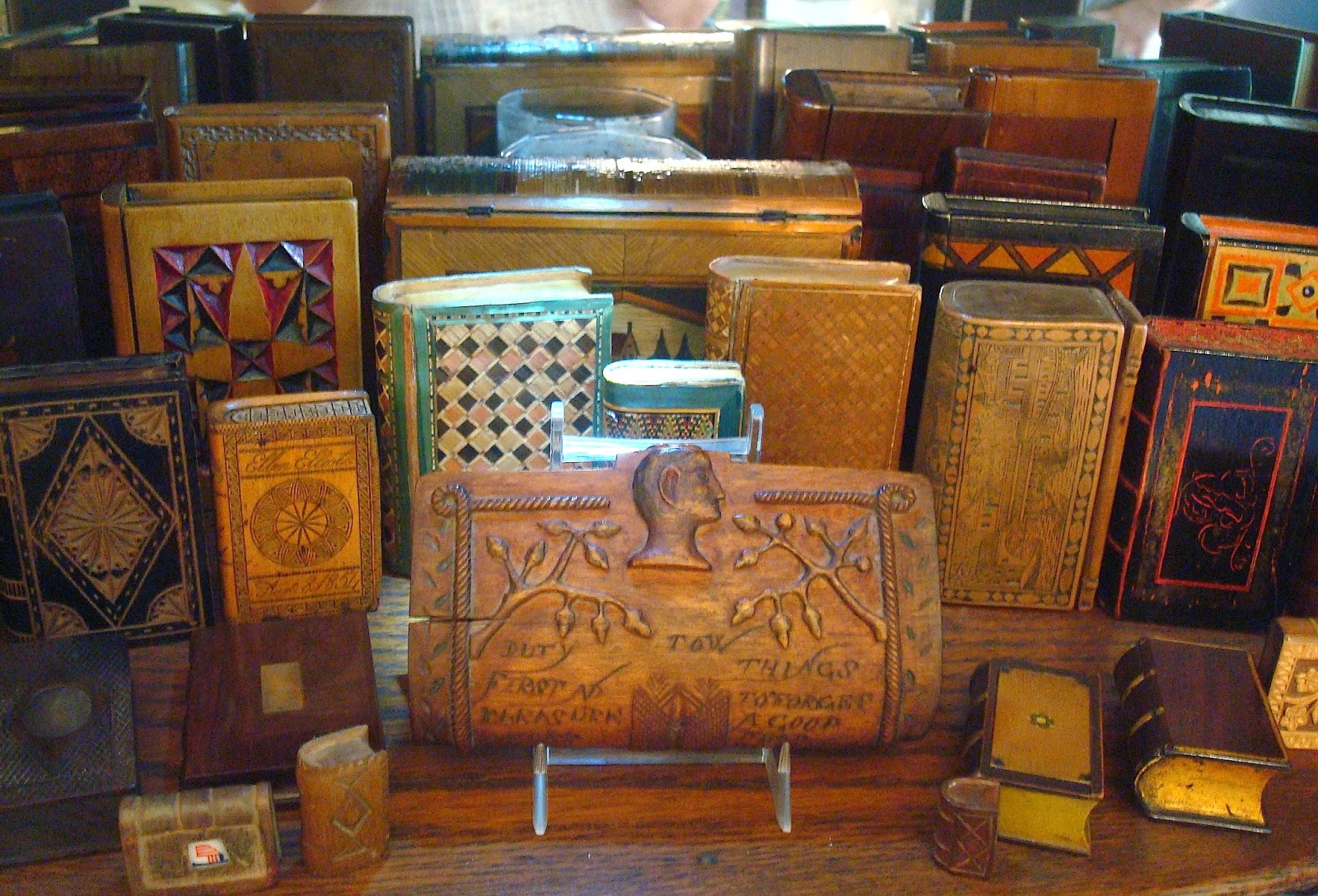
Showing posts with label book-shaped. Show all posts

Wednesday, June 29, 2016

Video of the Grolier Club Colloquium: Blooks: The Art of Books That Aren't

On February 2, Columbia University and the Grolier Club sponsored an evening colloquium in conjunction with my exhibition Blooks: The Art of Books That Aren't. The symposium was filmed and the film is available on the Grolier Club website.


Here is a link: https://vimeo.com/158427834


Here is the program of speakers:


Colloquium in conjunction with the exhibition

Blooks: The Art of Books That Aren’t

January 28-March 12, 2016
 
Sponsored by Columbia University and the Grolier Club

Tuesday, February 2
Hours: 6:00-8:00 PM
 
Program

Moderator, Karla Nielsen, Ph. D., MSLIS. Curator of Literature. Rare Book and Manuscript Library, Columbia University

The Larger View of Blooks
Mindell Dubansky
Museum Librarian - Preservation, The Sherman Fairchild Center for Book Conservation, Thomas J. Watson Library, The Metropolitan Museum of Art

 Collecting Antiquarian Book Objects
Private collecting team, Bruce and Lynn Heckman

The Book as Object
Lynn Festa
Associate Professor of English. Department of English, Rutgers University.

Panel Discussion and Questions. Reception.


Thursday, March 3, 2016

BLOOKS review by Claire Voon from the Hyperallergic website March 2

J. & Company, “Instructeur Magnétique Américain. Grammaire” (c. 1870–90), a French educational grammar game (all photos by the author for Hyperallergic)
Books exist as receptacles of information, but for many years people have adopted
their format and appearance to create other objects or containers for an array of items.
Such objects are referred to as “book-looks” — or “blooks,” a term coined by Mindell Dubansky,
a preservation librarian at the Metropolitan Museum of Art’s Thomas J. Watson Library
who has over the years amassed hundreds of examples. A sample of her growing collection is
now on view at the Grolier Club in the exhibition Blooks: The Art of Books that Aren’t,
filling the shelves of its second floor gallery with over 100 objects that resemble books,
illustrating our fascination with their design and architecture rather than simply the contents
of their pages. Most of the ones that can open are arranged in ways that show both their
outsides and interiors, making for a thoughtful and extensive display.
The variety of blooks — both handmade and commercially manufactured, and constructed
of all types of material — is remarkable and overwhelming, with some items dating as far
back as the late 18th century. As you may expect, many of these creations take advantage
of the format of a book to hide items of personal value in hollowed-out areas, perfect for
camouflaging on a shelf. Children’s coin banks, for instance, hide behind misleading covers
 that market the vaults as encyclopedias. On view, too, are slender cases meant to hold
recipes in the shape of a seven-volume recipe book — in which one previous owner once
hid a personal letter regarding “her unsuitable conduct and questionable behavior.”
This potential to conceal also led to a number of blooks for impish entertainment: beyond
classic board games (and even educational ones), some blooks were mass-produced as gags.
One 19th-century trick book stashes a snake that emerges open-mouthed from its wooden
lair if you tug a string. The exhibition also features an entire case of “punchline” books
that deliver jokes — at times silly, at times shocking — to viewers upon the opening of
their “pages.” One absurd title, for instance, suggests it will advise on how to save the hair
of those in fear of balding; upon opening it, however, you instead see a compartment for
literally preserving locks.
Other containers adopted the design of a book simply for aesthetic reasons, serving as
practical objects while nodding to what was perhaps their owners’ passion for reading —
or at least a desire to present the illusion of intellect. Someone once organized his or her
office supplies in a large tome, and one woman kept her 14-piece vanity set in a blook
with an elaborate 1920s-style cloth binding. Then there’s the very meta “book repair kit,”
which came complete with an eraser, mending tape, sponge, glue, and its very own book:
an instruction manual to properly proceed with mendings. On the flip side, other blooks,
from ceramic ashtrays to lighters with decorated dust jackets, focused only on the
superficial look of a book and do not open at all.
Many of these objects are admittedly slightly kitschy, but the unexpected shedding of pages
 — what makes books symbols of knowledge — to simply having the image of a book
around you is what makes blooks particularly endearing. Still, some blooks offer more
than just their unique physical presence and do hold sentimental value for their owners.
One cabinet in the exhibition features a number of wooden love tokens and small,
palm-sized memorials carved with tender texts to loved ones, all created in the shape
of books. Although unassuming and easy to glance over compared to larger, impressive
volumes, they have the same power of the tomes they emulate, serving to transport the
mind and heart in deeply meaningful ways.

Trick snake book (mid-to-late-19th c.)


Trick snake book (mid-to-late-19th c.) (click to enlarge)

A stamp holder
A hand-carved wooden cigarette case (1914-1917)
A framed faux box with three-dimensional open books showing decoupage images of famosu European paintings (mid-20th c.)
A framed faux box with three-dimensional open books showing decoupage images of famous European paintings (mid-20th c.)
Crowell, Collier and McMillan, "Your Future" (1950s-60s), a child's book-coin bank
Crowell, Collier and McMillan, “Your Future” (1950s-60s), a child’s book-coin bank
Hand-carved slate memorial book, inscribed with "In Memory" on the spine and "In, God. We, Trust" on the cover
Hand-carved slate memorial book, inscribed with “In Memory” on the spine and “In, God. We, Trust” on the cover
Philip V. Spinner & Company, "Smoke and Ashes [by] Flame" (1927), a smoking set
Philip V. Spinner & Company, “Smoke and Ashes [by] Flame” (1927), a smoking set
Writing or tea box with a paper theater (late 18th to mid-19th c.)
"How to Save Your Hair" (1941 edition of mid-19th c. publication)
“How to Save Your Hair” (1941 edition of mid-19th c. publication)
Reversible Collar Company, "Album Collar", a collar box for a new and improved cotton and paper collar (1870s)
Reversible Collar Company, “Album Collar”, a collar box for a new and improved cotton and paper collar (1870s)
A carved maple sugar mold in the shape of a bible, likely meant for a communal holiday meal or funeral (c. 1820s)
Marble memorial box (19th c.)
"The Care and Feeding of Books" (1947), a book repair kit
“The Care and Feeding of Books” (1947), a book repair kit
Blooks: The Art of Books That Aren’t continues at the Grolier Club (47 East 60th Street, Manhattan) 
through March 12.

The last public tour of the show will be next Thursday, 1-2. 
You can purchase a catalog via this blog, 
or contact me at mindelldubansky@gmail.com.

THANK you Hyperalleric and Claire Voon for this 
wonderful review. Here's a link to the original:
http://hyperallergic.com/279766/the-aesthetic-allure-of-books-without-pages/

Wednesday, October 14, 2015

A Sample of "Blooks: The Art of Books That Aren't"

Hello Readers, 

Since the New Year (2015) I've been doing all of the things necessary to raise the funds for, promote and prepare the exhibition and catalog Blooks: The Art of Books That Aren't (Grolier Club [NYC], January 28-March 12, 2016).  It's taken all of my skills and pointed out the ones I don't have. Now that the illustrated catalog is at the printer, I can come up for a breath of air. I look forward to getting back to posting about interesting blook trends, but have patience. 

Both the exhibition and its catalog follow a thematic arrangement that illustrates fourteen genres of book objects. In the exhibition, there will also be a miniature exhibit with a chronological arrangement of tiny blooks, to give visitors an impression of the developmental evolution of blooks in a nutshell. The exhibition illustrates about 250 years of blook history, from the eighteenth century to the present. There are 130 objects in the show that are also illustrated and described in the catalog. The exhibition will have additional objects, including in-depth looks into two blook genres and new acquisitions, including the 18th century Catholic portable book altar shown below. Here is a peek into the themes with an example from each: 


Religion

Catholic portable book altar, European. 18th century.


Commemoration

Stone memorial book. In Memory. American, 19th century.


Photography

Daguerrotype case. Friendships Offerining. American or English. Nineteenth century.


Travel Souvenirs

Stone books. Souvenir of the Soldier's Home. Hot Springs, South Dakota. American. 1916.


Stimulating substances

Table lighter. Book of Smoking Knowledge. Ross Electronics Corp. American, 1960s. 


Food and Candy

Chef-an-ette.   Terry's Originettes. American. Late 1930s.


Grooming and Fashion

Anya Hindemarch clutch bag. Chelsea Husbands. English. 1990s.


Needlework

Yarn box. Knitting Volumes. American. 1940s-1950s.


Household Items


Alarm clock. Lava Time. Lava Simplex. American. 1976.


Books and Writing 

Book repair kit. The Care and Feeding of Books. American. 1947.


Gags

Snake book. What I Know About Women. Japan. 1950s-1960s.


Props

TV or theatrical prop. Manon Lescaut and Les Chinois de Paris. American. Late 20th century. 

Games and Toys

Toy spy camera. Secret Sam Camera Book. Topper Toys. American. 1960s.


Safes and Banks

Coin bank. Book Bank. English. 1970s.


Please send this post to your book-loving friends, come to the exhibition and purchase the catalog. I will be at the Grolier Club giving public tours of the exhibition, every Thursday from January 28 through March 10. To keep up with exhibition events, check in with the Grolier exhibition page, or visit the Grolier Club website. The catalog is being finished now and will be ready in early January. To order copies, contact me at mindelldubansky@gmail.com ($45 plus $6 s&h). 

First page, Introduction:


Sunday, April 5, 2015

Blook Game Boards

I was surprised to come across this English book (1903) that depicts a book-shaped game board on its cover (see the lower left corner). While I haven't seen other titles from the Club Series and I don't know how many titles were included, I'm assuming that this was a popular game book series and that this binding design appears on all of its titles. It's the first time I've seen a blook as an illustration. Its prominent presence on the cover is obviously an indication of how familiar people must have been with book-like game boards at the turn of the twentieth century. 


Perhaps you have seen book boards in antique shops and flea markets. There are still quite a few about today, although many are worn and damaged from years of use and the degradation of materials. They often have catchy titles, I have one named Evening Pastimes, Vols. 1 and 2. Once again the book form is a perfect vehicle for a container, adding interest and style to whatever it is applied. 

Book game boards from this period (late 19th-early 20th centuries) are usually for the games of chess, checkers and backgammon. On the board above you can see what an example of a two-volume game boards for chess, checkers and backgammon look like. This is one of many different variations. With its gold-tooled leather binding, it could easily be mistaken for real books if it was placed on a bookshelf. I have also seen the boards covered in paper, printed in chromolithography and in rustic handmade versions carved from wood. 


This is a similar board, but a less expensive version, covered in printed paper (chromolithography), rather than leather. The title is  Life of Hoyle, in two volumes. It is most probably a play on the popular book Hoyle's Rules for Playing Fashionable Games, published in many editions since the late eighteenth century. 


GO BANG!:


The Games of Go Bang, Tivoli and Fox and Geese is another example of a book game board, less common than the chess/checkers/backgammon version. I have a copy in black but you can see here that it was also made in a dark red paper version. You can see it in person if you attend my exhibition next winter at the Grolier Club. 

I hope you will all send pictures and descriptions of similar boards or other titles from the Club Series that you may see or have. Many games and puzzle containers are still made in book form today, it's an abiding tradition that has lasted more than two centuries. For an example of an even older book game box, see this post about the Heckman collection.


Tuesday, August 19, 2014

How a Patent Can Shed Light on Blooks. Case Study, "Secrets of the American Cup"

When I first get a new blook or at the time of cataloging it, I look closely for any patent information and search for an original patent document. If the object is American, it couldn't be simpler, as these can be searched and downloaded using Google Patents. Many objects may have some version of "Patent Applied For" printed on them, but I'm fairly sure that while this was a deterrent to the theft of a design, most of these objects were never patented. Having said that, I haven't done a thorough patent search for objects in this category, so I could be wrong. 

In the case of secret book flask, Secrets of the American Cup, or, The Cause of the Controversy (Vol. 1, by Richmond B. Stoehr), the patent information was subtly blind-stamped on the interior of the top opening flap. It isn't easy to read, but shows the name if the inventor (Charles A. Brackett) and the U.S. patent date (Jan. 13, 1903). There is a detailed photograph of the stamp below. 

There are all kinds of great reasons to search for patents. What's so wonderful about them, is that you always find out something interesting about the object. Some examples of this are:
  • Some objects, as purchased, are incomplete and the patent will show you how they were originally envisioned by the inventor. 
  • You can see and read about how the object is constructed and what materials were used.
  • You find out more about the inventor, such as their gender, where they were from, what company they worked for or owned, etc.
  • You find out if there were revisions to the original design and what version of the object you have.
  • Sometimes you accidentally find a patent for an object by browsing Google Patents and this tells you that something you thought was unique, is not.
  • Some objects, such as in the case of Secrets of the American Cup, are shown in the patent as a having a slightly different function.
There are a number of blooks (as well as patented bookbinding structures) in my collection that I have found patents for. This is only one example. In this case, the patent shows that the inventor chose to illustrate this box as a candy box in the patent, although he does mention that it could be used for a bottle or flask in the text. 


Tuesday, July 29, 2014

Guest Post: Spruce Boxes from Bruce and Lynn Heckman

Bruce and Lynn Heckman

This past Sunday, I had the pleasure of visiting Bruce and Lynn Heckman to see their remarkable collection of over 1,000 unique, folk art book objects. This is certainly the largest collection of its kind, certainly larger than mine which is only a little over 500. I was expecting to see a substantial collection of unique objects, but I was amazed by the breath and beauty of the collection, the extended show-and-tell viewing and the enthusiastic reception that Lynn and Bruce gave me. I’m not sure I have yet digested what I have seen, but I don’t think I will ever forget the wonderful, inspiring day I had with them. I think I'll make another post later to show a few of the blooks I took photos of that particularly interested me.


One of many shelves of book-boxes in the Heckman's collection
Lynn and Bruce collect as a team and the joy they share in collecting is reflected in the picture of them holding a large book box. They collect many types of book objects, but the largest single category, from a media perspective, is that of  carved wooden boxes with various functions, made during the 18th through 20th centuries. Sewing boxes, puzzle boxes, snake boxes, love-gift boxes, solid carved books, Civil War lancet boxes, banks and safes were all represented; however, the most prominent group within the wooden boxes were the charming American and Canadian spruce gum boxes. Bruce and Lynn provided this post for us so that we can learn more about the history of the spruce gum book box:

Spruce Gum Boxes in the Form of Books
by Bruce and Lynn Heckman


Spruce gum boxes are manifestations of the same impulses that drive the creation of much Folk Art:  Love, moral fervor, whimsy, loneliness due to isolation, and an excessive availability of time. The chewing of gum has been going on for 5000 years, since Neolithic times.  Spruce gum was excreted by trees in the North Woods of Canada and the U.S. and harvested by lumbermen to put in boxes to bring home to loved ones for their chewing  enjoyment. Carving of the boxes spans the 1870's to the 1920's, though some modern examples exist. Modern boxes have a lack of patina that cries out to you after you've handled enough boxes.  We think that some boxes with patriotic were produced for the American Centennial of 1876.


Books were the models for almost all spruce gum boxes, though many were made in the form of a barrel. Bookishness is not normally associated with the lumbermen of the North Woods, but the book icon was widely adapted.  The book-shaped boxes appeal from the tactile, visual, and historical points of view.  Most fit nicely in the hand and were about five inches tall, although some are as small as two and one-half inches and as tall as thirteen inches. Carving varies from the simple to the very intricate. Paint and stains are used, as well as photographs, applied hearts, mirrors, found objects, and colored beeswax. Some boxes have the names of people and places, dates, and sentimental expressions.


Time was abundant in the North Woods and, after a day of felling trees, the nights were occupied with box carving.  The design was made, the piece of wood hollowed out from both ends, and slides were made for the top and bottom.  The decoration was carved and applied and the boxes sealed with shellac.  The heart was the most common decoration and signifies that these objects were created for loved ones at home.  Extensive chip carving was used.  Anchors, ropes, stars, crosses, tree of life, and geometric shapes were incised or applied.


We have been collecting spruce gum boxes since July 1989. Since then, our collection has grown to approximately one hundred boxes. These are part of a much larger collection of 'blooks' spanning three centuries and many countries. The spruce gum boxes appeal to us for their artistic, sentimental, and historical aspects.  We have enjoyed the collecting hunt and sharing our collection with interested collectors.


_______

Record Image
Maine State Museum Collection
If readers would like to see and learn more about spruce boxes, the Maine State Museum has very good images and descriptions of the boxes on their online website.

Click here to read an article about spruce gum from Northern Woodlands Magazine.  

Ian Berke recently sent this picture of three source gum boxes he recently saw at the
Maine State Museum.