Showing posts with label book object. Show all posts

Sunday, April 5, 2015

Blook Game Boards

I was surprised to come across this English book (1903) that depicts a book-shaped game board on its cover (see the lower left corner). While I haven't seen other titles from the Club Series and I don't know how many titles were included, I'm assuming that this was a popular game book series and that this binding design appears on all of its titles. It's the first time I've seen a blook as an illustration. Its prominent presence on the cover is obviously an indication of how familiar people must have been with book-like game boards at the turn of the twentieth century. 


Perhaps you have seen book boards in antique shops and flea markets. There are still quite a few about today, although many are worn and damaged from years of use and the degradation of materials. They often have catchy titles, I have one named Evening Pastimes, Vols. 1 and 2. Once again the book form is a perfect vehicle for a container, adding interest and style to whatever it is applied. 

Book game boards from this period (late 19th-early 20th centuries) are usually for the games of chess, checkers and backgammon. On the board above you can see what an example of a two-volume game boards for chess, checkers and backgammon look like. This is one of many different variations. With its gold-tooled leather binding, it could easily be mistaken for real books if it was placed on a bookshelf. I have also seen the boards covered in paper, printed in chromolithography and in rustic handmade versions carved from wood. 


This is a similar board, but a less expensive version, covered in printed paper (chromolithography), rather than leather. The title is  Life of Hoyle, in two volumes. It is most probably a play on the popular book Hoyle's Rules for Playing Fashionable Games, published in many editions since the late eighteenth century. 


GO BANG!:


The Games of Go Bang, Tivoli and Fox and Geese is another example of a book game board, less common than the chess/checkers/backgammon version. I have a copy in black but you can see here that it was also made in a dark red paper version. You can see it in person if you attend my exhibition next winter at the Grolier Club. 

I hope you will all send pictures and descriptions of similar boards or other titles from the Club Series that you may see or have. Many games and puzzle containers are still made in book form today, it's an abiding tradition that has lasted more than two centuries. For an example of an even older book game box, see this post about the Heckman collection.


Wednesday, March 4, 2015

New Lectures: "BLOOKS for the Masses: Fantasy and Invention in Book Objects" and "The Art of Books That Aren't: A Survey of Historic Book Objects"

All proceeds from these lectures will go towards the publication of an exhibition catalog for The Art of Books That Aren't. Grolier Club, January 28-March 14, 2016.  Please contact me if would like to plan a lecture for your class or group or if you are able to make a donation towards the exhibition, the catalog and its programs (mindelldubansky@gmail.com):

Blooks for the Masses: Fantasy and Invention in Book Objects


Blooks for the Massesis a chronological romp through the evolution of American patented book-objects, designed during the nineteenth and twentieth centuries. It will feature approximately fifty patents for practical and fanciful book objects of all kinds. In addition to patent drawings, Ms. Dubansky will discuss the objects’details as they relate to book culture and illustrate real objects that were produced from, or closely resemble, those produced from the patents.

 
The objects in the talk date from the 1860s to the 2010s. They elucidate how book objects were integrated into popular culture and how the commercial sector has developed the book form to add interest, function and market value to every-day objects. Items in this presentation are wide-ranging and include examples of objects made for the home, office, school and beyond. Shown here is a patent for a lunch-box (1875; patent 170,441) and Noonday Exercise, an unattributed toleware lunch box of a similar style and date.


The Art of Books That Aren't: A Survey of Book Objects

 
If you aren't able to come to my blook exhibition at the Grolier Club exhibition next year, but wish you could, this is the lecture for you. It is a thematic romp through the history of book objects made from the eighteenth century through today. This presentation will describe a wide variety of handmade and manufactured book objects and place them in historic context through discussing their inventors, marketing history and use -- and showing many beautiful images of book objects. This lecture can be shaped to address the specific needs of a particular audience, if requested. 


Hand warmer or flask. First half of the 18th century. British. Tin-enameled earthenware. Metroplitan Museum of Art, 37.123.3


Friday, December 12, 2014

Bible Book Blocks


Educational Device. Book of Books. Sixty-six books of the Bible, wood block set, missing book-shaped slip-case.

I wonder if any of you have seen book Bible block sets before. After collecting book objects for many years, I'm just starting to see Bible blocks emerge as a genre of book object. To date, I've seen approximately five variations. The sets I have seen are both handmade and manufactured (and patented). All are wood, some with printed paper covers and are stored in wood boxes that double for bookshelves. They are part of the tradition of teaching children to memorize the sixty-six books of the Bible. I don't know why it is important to memorize the books, especially if the book themselves are at hand, but I can see that it is a traditional tool  for Christian education. Faux books of the Bible are still ingrained in our culture. For example, I saw a website that shows Bible book covers that can  be attached to cereal boxes and used in Bible book memorization games. 

The Block Book Library seen below is a commercial set from the collection of the Museum of Play (Strong Museum) in Rochester, New York.


Evidence of an ongoing tradition of Bible blocks, repurposing cereal boxes.

Thursday, October 30, 2014

Happy Halloween!

 
We had our monthly book conservation open house today and decided to make it a Halloween party and drag some of my Halloween book props. Here are only a few.
 
This is a tableau we made with another book prop to correspond to a Museum painting. It and the painting will be on the In Circulation Facebook site tomorrow:
 
 
Happy Blookoween!


Monday, October 20, 2014

An Alarming Hybrid. An Exploding Publishers' Binding


Exploding book. Kelco Loud Book: A Great Warning to You on Preparedness. Wake Up. An Alarming Report. Designed and sold by John J. Reinhold, Marietta, Pa. American. c. 1912.
Stamped cloth publisher's binding, binders waste, metal trap
14.7 x 9.2 x 1.5 cm

Unlike later gag exploding or shooting books which were made from altered books, those seen from the first decade of the 20th century are custom-made, probably by commercial bookbinders. This book has a wonderful publisher’s binding of cream plain-weave cloth, stamped in red and blue. The book lists two US patents (1041095; 1166053) which are for the shooting mechanism.
If you are a blog follower, you might remember this example of an 1930s exploding book in this post I showed awhile back. http://aboutblooks.blogspot.com/search?q=exploding+book.


In that post I alluded to an earlier group of exploding books from the beginnng of the 20th century. I've found two recently, both by Kelco. I'm very excited about this one for several reasons: First it is a link between the bindery trade and the gag books trade. It is a publisher's binding, custom designed for this object. It is a glorious binding in great condition. It is not an altered book; but has a text block made up of pages from binder's waste. The last great thing about it is that the patented exploding mechanism (aka mousetrap) is different from any I have previously seen. For the record, it's also the second exploding book I have seen that makes a pun of the word 'report', the other being one I saw an ad for, titled Teddy's Report. While rare today, these books were once published by the thousands in numerous design variations and titles.


Thursday, September 18, 2014

New to the Collection: A Box With Arabic Writing.

This week I had a visit from an old friend, artist book publisher, Gunnar Kaldewey. I haven't seen Gunnar for about a year, as he is now living abroad. To my surprise he arrived with this beautiful wood book box which he purchased in a Paris antiques market. He told me that he thought it dated from the early 20th century. His colleague told him that the lettering said "Images." The box is inlaid with various tpes of wood and metal. Other than that, we don't know anything about it at this time and more resarch is required to have a better understanding of it's purpose and origin. Be sure to comment if it has meaning for you. If you'd like to know about Gunnar's work, you might want to see this book.


Tuesday, August 19, 2014

How a Patent Can Shed Light on Blooks. Case Study, "Secrets of the American Cup"

When I first get a new blook or at the time of cataloging it, I look closely for any patent information and search for an original patent document. If the object is American, it couldn't be simpler, as these can be searched and downloaded using Google Patents. Many objects may have some version of "Patent Applied For" printed on them, but I'm fairly sure that while this was a deterrent to the theft of a design, most of these objects were never patented. Having said that, I haven't done a thorough patent search for objects in this category, so I could be wrong. 

In the case of secret book flask, Secrets of the American Cup, or, The Cause of the Controversy (Vol. 1, by Richmond B. Stoehr), the patent information was subtly blind-stamped on the interior of the top opening flap. It isn't easy to read, but shows the name if the inventor (Charles A. Brackett) and the U.S. patent date (Jan. 13, 1903). There is a detailed photograph of the stamp below. 

There are all kinds of great reasons to search for patents. What's so wonderful about them, is that you always find out something interesting about the object. Some examples of this are:
  • Some objects, as purchased, are incomplete and the patent will show you how they were originally envisioned by the inventor. 
  • You can see and read about how the object is constructed and what materials were used.
  • You find out more about the inventor, such as their gender, where they were from, what company they worked for or owned, etc.
  • You find out if there were revisions to the original design and what version of the object you have.
  • Sometimes you accidentally find a patent for an object by browsing Google Patents and this tells you that something you thought was unique, is not.
  • Some objects, such as in the case of Secrets of the American Cup, are shown in the patent as a having a slightly different function.
There are a number of blooks (as well as patented bookbinding structures) in my collection that I have found patents for. This is only one example. In this case, the patent shows that the inventor chose to illustrate this box as a candy box in the patent, although he does mention that it could be used for a bottle or flask in the text. 


Monday, August 4, 2014

More Treasures from the Heckman Collection

In the post about my visit to Bruce and Lynn Heckman, I promised I'd create another post to show you a mix of the incredible objects that I enjoyed seeing and was able to get snapshots of. I could have gone on forever but we were going through the collection at break-neck speed and taking pictures was a distraction from looking. I did get a few though, and will share these with you here. I'll probably break them up into more than one post, so keep a lookout for more! 

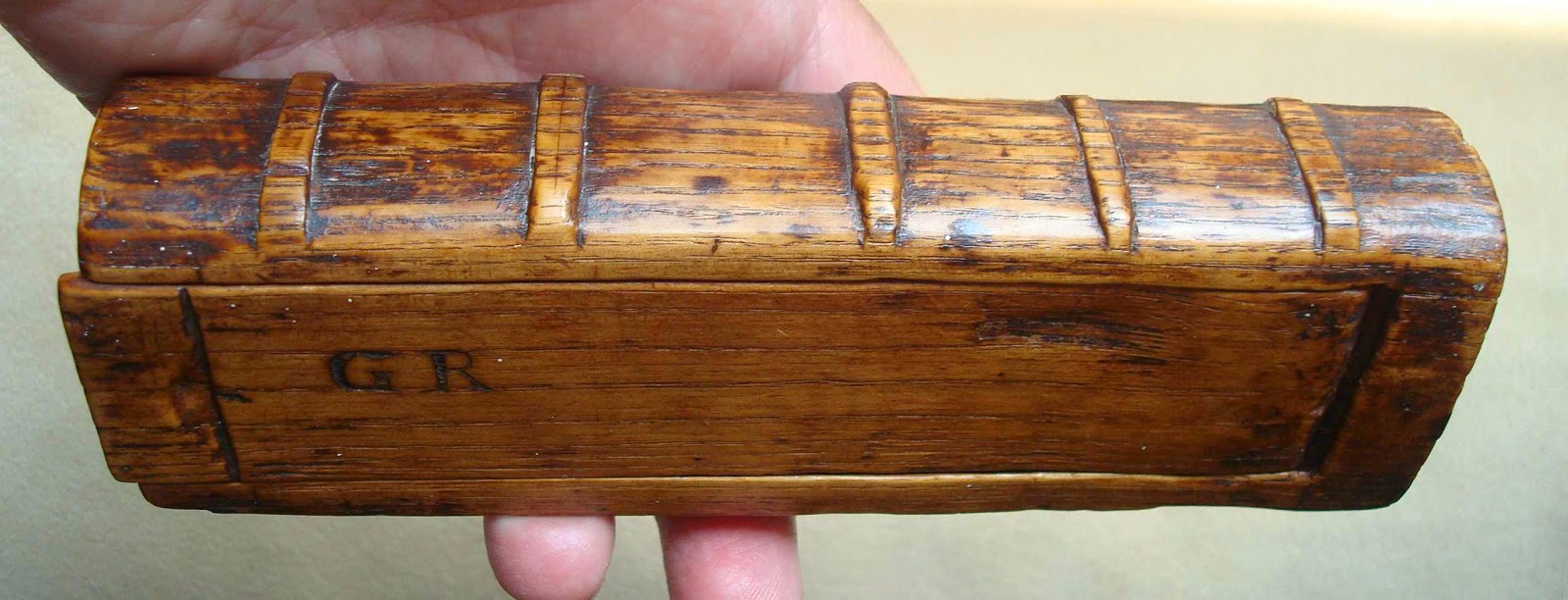
Bruce tells us that this is either an adult word game or a learning device for children.  GR stands for George Rex, King of England. It is from the late 18th, or early 19th century.
 

An exuberantly decorated carved case for a sprint-loadel phlegm (lancet). American Civil War era:


My personal favorite, a blook pincushion. The cushion has a 'bird' to attach it to a table and a post to hold thread for lacemaking:


A toleware pencil box, dated 1874 (American). The case shows wear, but Bruce says it's the only one he has seen, as yet:

 
Bruce wrote to tell me that he is working on a post on his trick snake books. 
You are in for a treat...


Thursday, July 31, 2014

Guest Post: Ian Berke on Stone Books

Ian Berke collects stone books, and only stone books. I recently met Ian when he was visiting New York from his home in San Francisco. Eve Kahn, who wrote an article about both of our collections in the NY Times, brought him to the Met to meet me and from then on we've kept in touch. Eve had promised me that things happen when her articles appear and they have. Meeting Ian and other collectors has been a wonderful benefit of the publicity. Recently, Ian and I received an enquiry about stone books from a NY Times reader. Ian kindly granted permission for me to adapt his thoughtful response for this post. It provides some of his insights into the nature and history of stone book objects. The photographs are from Ian, the captions are mine:


Stone book carved in the Eastlake Style

Notes on Stone Books from Ian Berke

So few people collect (much less know about) stone books. I've been collecting them for about 15 years and have nearly 300.  I am trying to write an article for MAD (Maine Antique Digest), and am doing a statistical analysis of the books (i.e. percentage with female names vs. male names, dates, iconography, inscriptions, etc.). There are generally two types of books: tourist/souvenir books and personal books. Although I have a number of tourist books (Garden of the Gods, etc), the personal books are far more interesting. My feeling is that most were done as after hours work by stone cutters as gifts for friends and lovers.   They tend to be much more skillfully done, but there are also those that are charmingly folky. Clearly done by those with no stone cutting skills. The use of the closed book seems to me to be a reference to the Bible, which was important to 19th & early 20th century Americans in a way that is difficult to appreciate today. Many books have explicit religious iconography or inscriptions (Holy Bible, crosses, anchors, crowns, etc) but most do not.   Some are clearly memorials, and may have tintypes (or later photos) set into the cover.


A marble book made in the form of an album. Many book objects from the latter 19th century are made to emulate photograph albums.

Provenance is something that has driven me crazy. I had expected to find many with accompanying documentation saying "my grandfather carved this in 1885, etc, but in fact once the book has left the family, nearly always any record of ownership disappears. A very very few (3 out of 300) state "made by _____" but they are rare. Most books are carved from marble, siltstone, limestone, slate (rare), and other sedimentary rocks.  Marble obviously a metamorphic rock. Harder stones, such as granites and diorites are rare presumably because it was much more difficult to carve. Agate, which is quite hard (Mohs 7), is usually restricted to very small books. Alabaster and catlinite (pipestone) is also seen.   Catlinite more for tourist books from Minnesota. Italian books are immediately recognizable by the use of different highly ornamental marbles carefully fitted together.


This marble, delicately carved and gilt book features a portrait of Harry. Folk art book objects often feature photos of the giver or receiver of a gift or memorial blook. 

There are also prison books, done by inmates, most from the Iowa State Penitentiary in Anamosa. I have 3 or 4 really good ones. Stone books are getting harder to find, especially the ones with inscriptions. I am particularly interested in dated books, which show that most were made from about 1870 through 1910. My earliest is 1857 and the latest 1937, but those are real outliers.  I go on forever.

Ian Berke

And a few more of Ian's stone books photographed on a background of one inch blocks, for scale:

Heart, hand and pencil in relief; a powerful image of love

Mizpah books are memorials

A beautiful and sentimental gift book

Another version of a faux album, is it Masonic?

Joey sent a comment on the Heckman collection post that leads us to a blogpost on another stone book: http://anonymousworks.blogspot.com/2014/03/19th-century-folk-art-carved-odd.html

UPDATE: There is a new article (April 2015) out on Ian's stone book collection in the Maine Antiques Digest

Tuesday, July 29, 2014

Guest Post: Spruce Boxes from Bruce and Lynn Heckman

Bruce and Lynn Heckman

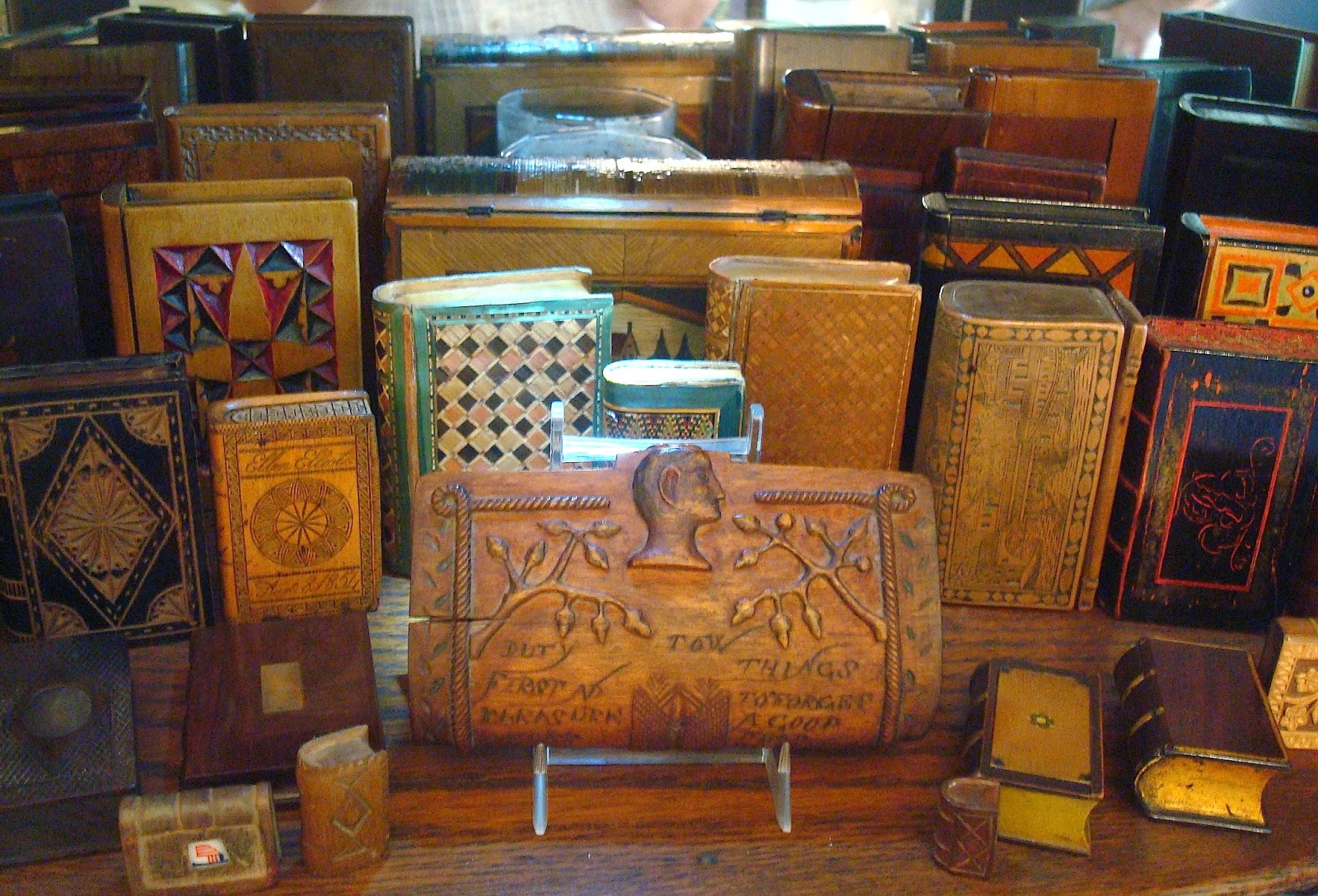
This past Sunday, I had the pleasure of visiting Bruce and Lynn Heckman to see their remarkable collection of over 1,000 unique, folk art book objects. This is certainly the largest collection of its kind, certainly larger than mine which is only a little over 500. I was expecting to see a substantial collection of unique objects, but I was amazed by the breath and beauty of the collection, the extended show-and-tell viewing and the enthusiastic reception that Lynn and Bruce gave me. I’m not sure I have yet digested what I have seen, but I don’t think I will ever forget the wonderful, inspiring day I had with them. I think I'll make another post later to show a few of the blooks I took photos of that particularly interested me.


One of many shelves of book-boxes in the Heckman's collection
Lynn and Bruce collect as a team and the joy they share in collecting is reflected in the picture of them holding a large book box. They collect many types of book objects, but the largest single category, from a media perspective, is that of  carved wooden boxes with various functions, made during the 18th through 20th centuries. Sewing boxes, puzzle boxes, snake boxes, love-gift boxes, solid carved books, Civil War lancet boxes, banks and safes were all represented; however, the most prominent group within the wooden boxes were the charming American and Canadian spruce gum boxes. Bruce and Lynn provided this post for us so that we can learn more about the history of the spruce gum book box:

Spruce Gum Boxes in the Form of Books
by Bruce and Lynn Heckman


Spruce gum boxes are manifestations of the same impulses that drive the creation of much Folk Art:  Love, moral fervor, whimsy, loneliness due to isolation, and an excessive availability of time. The chewing of gum has been going on for 5000 years, since Neolithic times.  Spruce gum was excreted by trees in the North Woods of Canada and the U.S. and harvested by lumbermen to put in boxes to bring home to loved ones for their chewing  enjoyment. Carving of the boxes spans the 1870's to the 1920's, though some modern examples exist. Modern boxes have a lack of patina that cries out to you after you've handled enough boxes.  We think that some boxes with patriotic were produced for the American Centennial of 1876.


Books were the models for almost all spruce gum boxes, though many were made in the form of a barrel. Bookishness is not normally associated with the lumbermen of the North Woods, but the book icon was widely adapted.  The book-shaped boxes appeal from the tactile, visual, and historical points of view.  Most fit nicely in the hand and were about five inches tall, although some are as small as two and one-half inches and as tall as thirteen inches. Carving varies from the simple to the very intricate. Paint and stains are used, as well as photographs, applied hearts, mirrors, found objects, and colored beeswax. Some boxes have the names of people and places, dates, and sentimental expressions.


Time was abundant in the North Woods and, after a day of felling trees, the nights were occupied with box carving.  The design was made, the piece of wood hollowed out from both ends, and slides were made for the top and bottom.  The decoration was carved and applied and the boxes sealed with shellac.  The heart was the most common decoration and signifies that these objects were created for loved ones at home.  Extensive chip carving was used.  Anchors, ropes, stars, crosses, tree of life, and geometric shapes were incised or applied.


We have been collecting spruce gum boxes since July 1989. Since then, our collection has grown to approximately one hundred boxes. These are part of a much larger collection of 'blooks' spanning three centuries and many countries. The spruce gum boxes appeal to us for their artistic, sentimental, and historical aspects.  We have enjoyed the collecting hunt and sharing our collection with interested collectors.


_______

Record Image
Maine State Museum Collection
If readers would like to see and learn more about spruce boxes, the Maine State Museum has very good images and descriptions of the boxes on their online website.

Click here to read an article about spruce gum from Northern Woodlands Magazine.  

Ian Berke recently sent this picture of three source gum boxes he recently saw at the
Maine State Museum.


Saturday, July 12, 2014

Guest Post: A Proud Blook Owner, David Prowler on Saul Steinberg

As you can imagine, I was thrilled to have my blook collection written up in the NY Times yesterday. One of the pleasant outcomes has been hearing from readers about their special book objects. David Prowler sent this guest post on his one and only book object that is also a work of art by Saul Steinberg:

I’ve only got one blook but if my apartment caught fire I’d grab it. I came across it in an auction catalogue called ”Fine Modern Literature, Sale 341, September 28, 2006”.  It was a little bit after “Stein, Gertrude, Lot of six titles”, in between “Steinbeck, John Lot of 8 volumes” and “Stevenson, Robert Louis, Island Nights’ Entertainments”.  But it’s not literature or even a book.  It’s:

Steinberg, Saul

1977
Description:
Wooden mock book, designed and illustrated by artist Saul Steinberg. 8x5½" & (¾" thick), with hand-coloring (white, black and tan), carved ruling, carved imitation page edges colored white, penciled “ST. 1977” in white box on front center, oval black ink vignette drawing / emblem below. Inscribed in pencil “For Jane, Happy Birthday and love, Saul St., March 1977.”
Condition: Impressions and rubbing, other light wear, still near fine.


I’m a big fan of Saul Steinberg, even wrote on my blog about him:  http://davidprowler.wordpress.com/2010/11/11/saul-steinberg-dottore-in-architettura/.

I’ve got books (signed and unsigned) and posters (signed and unsigned). I’ve got books in English, German, French, Spanish, and Czech.  There’s one out there in Japanese I should have bought when I had the chance.  It never occurred to me that I could own a unique original Steinberg, much less a sculpture, a blook.  But because it was sold in a book context rather than an art context, there wasn’t much bidding.  And now it is in a Plexiglas frame I made, sitting on my dresser.  

Macintosh HD:Users:david2:Desktop:photo 3.JPG


Macintosh HD:Users:david2:Desktop:photo 2.JPG

Thank you David!
I hope to hear from more of you soon.

Thursday, July 10, 2014

New York Times Article: Collecting Books That Are Just Covers


In tomorrow's New York Times, you will see an article that Eve M. Kahn wrote about my blook collection and on book-objects, in general. I've only just read it and saw that there was only room for two illustrations, so I will devote this post to showing you some of the pictures of and links for the other objects she mentions. I won't get them all in today, so check back later for the rest. Click here to read the article in full. 
These were the titles of the objects Eve mentions by name: Bitter Sweet flask, The Sandwich Islands, Noonday Exercises, The Informer alarm, Right the Wrong by E. Raser, World's Greatest Jokes, by R. U. Laffin, the Chef-an-ette and the Tea caddy/paper theater that broke the bank. Other blooks mentioned have already been illustrated in earlier posts on this blog. See if you can find Not So Dusty, by Y. B. Untidy and Crime Does Not Pay by Dusty Evsky.


Here is the late 18th-centruy tea caddy with a secret compartment for the lock and a paper theater embedded in the lid.


World's Greatest Jokes, by R. U. Laffin, is an electric shock book made by the Franco-American Novelty Co.


Noël Coward's souvenir Bitter Sweet flask, 1930, leather and gilt.Victoria & Albert Museum, no. S.2-1978. 


Noonday Exercises Lunch Box


The Informer. Heath. This link will take you to the Radio Museum site where you can see technical information and images about the Informer. The Informer always makes me chuckle because it is a hidden camera that makes itself very conspicuous, both by its title and the two large circular openings cut into the spine. It seems odd that they went to the trouble of having a real book cover made by a library binder an then cut two large holes in the spine which are very uncharacteristic for books. It would have worked better if the binding was black or the mesh was dark red.


This isn't my Chef-an-ette because I don't have a photo of it on this computer. Mine is the same model, but in black sides. I do very  much like the turquoise. You might also enjoy reading the story about on from someone for which it is a family heirloom. The Chef-an-ette came in a number of binding variants and volumes. I've seen them in 3, 5 and 7 volume variants and in three styles showing a change in taste from Art Deco to 50s modern. The Chef-an-ette was invented by Hazel Terry in 1938, but enjoyed popularity through the 1950s.  In the patent, it was titled Reference Device. It's one of my favorite blooks for so many reasons.